2.8. Butcher Tables
Here we catalog the full set of Butcher tables included in ARKODE. We group these into four categories: explicit, implicit, additive and symplectic partitioned. However, since the methods that comprise an additive Runge–Kutta method are themselves explicit and implicit, their component Butcher tables are listed within their separate sections, but are referenced together in the additive section.
In each of the following tables, we use the following notation (shown for a 3-stage method):
where here the method and embedding share stage \(A\) and \(c\) values, but use their stages \(z_i\) differently through the coefficients \(b\) and \(\tilde{b}\) to generate methods of orders \(q\) (the main method) and \(p\) (the embedding, typically \(q = p+1\), though sometimes this is reversed).
Method authors often use different naming conventions to categorize their methods. For each of the methods below with an embedding, we follow the uniform naming convention:
NAME-S-P-Q
where here
NAMEis the author or the name provided by the author (if applicable),Sis the number of stages in the method,Pis the global order of accuracy for the embedding,Qis the global order of accuracy for the method.
For methods without an embedding (e.g., fixed-step methods) P is omitted so
that methods follow the naming convention NAME-S-Q.
For SPRK methods, the naming convention is SPRK-NAME-S-Q.
In the code, unique integer IDs are defined inside arkode_butcher_erk.h and
arkode_butcher_dirk.h for each method, which may be used by calling routines
to specify the desired method. SPRK methods are defined inside arkode_sprk.h.
These names are specified in fixed width font at the start of each method’s
section below.
Additionally, for each method we provide a plot of the linear stability region in the complex plane. These have been computed via the following approach. For any Runge–Kutta method as defined above, we may define the stability function
where \(e\in\mathbb{R}^s\) is a column vector of all ones, \(\eta = h\lambda\) and \(h\) is the time step size. If the stability function satisfies \(|R(\eta)| \le 1\) for all eigenvalues, \(\lambda\), of \(\frac{\partial }{\partial y}f(t,y)\) for a given IVP, then the method will be linearly stable for that problem and step size. The stability region
is typically given by an enclosed region of the complex plane, so it is standard to search for the border of that region in order to understand the method. Since all complex numbers with unit magnitude may be written as \(e^{i\theta}\) for some value of \(\theta\), we perform the following algorithm to trace out this boundary.
Define an array of values
Theta. Since we wish for a smooth curve, and since we wish to trace out the entire boundary, we choose 10,000 linearly-spaced points from 0 to \(16\pi\). Since some angles will correspond to multiple locations on the stability boundary, by going beyond \(2\pi\) we ensure that all boundary locations are plotted, and by using such a fine discretization the Newton method (next step) is more likely to converge to the root closest to the previous boundary point, ensuring a smooth plot.For each value \(\theta \in\)
Theta, we solve the nonlinear equation\[0 = f(\eta) = R(\eta) - e^{i\theta}\]using a finite-difference Newton iteration, using tolerance \(10^{-7}\), and differencing parameter \(\sqrt{\varepsilon}\) (\(\approx 10^{-8}\)).
In this iteration, we use as initial guess the solution from the previous value of \(\theta\), starting with an initial-initial guess of \(\eta=0\) for \(\theta=0\).
We then plot the resulting \(\eta\) values that trace the stability region boundary.
We note that for any stable IVP method, the value \(\eta_0 = -\varepsilon + 0i\) is always within the stability region. So in each of the following pictures, the interior of the stability region is the connected region that includes \(\eta_0\). Resultingly, methods whose linear stability boundary is located entirely in the right half-plane indicate an A-stable method.
2.8.1. Explicit Butcher tables
In the category of explicit Runge–Kutta methods, ARKODE includes methods that have orders 2 through 9, with embeddings that are of orders 1 through 8. ARKODE’s explicit Butcher tables are provided in the enumeration
-
enum ARKODE_ERKTableID
with values specified in Table 2.17.
Method ID |
Stages |
Embedded Order |
Order |
|---|---|---|---|
1 |
— |
1* |
|
3 |
1 |
2* |
|
2 |
1 |
2 |
|
2 |
1 |
2 |
|
2 |
1 |
2 |
|
3 |
1 |
2 |
|
4 |
1 |
2 |
|
3 |
1 |
2 |
|
3 |
1 |
2 |
|
3 |
1 |
2 |
|
4 |
2 |
3* |
|
4 |
2 |
3 |
|
3 |
2 |
3 |
|
3 |
— |
3 |
|
4 |
2 |
3 |
|
10 |
3 |
4 |
|
5 |
3 |
4* |
|
5 |
3 |
4 |
|
6 |
3 |
4 |
|
7 |
3 |
4 |
|
6 |
3 |
4 |
|
7 |
4 |
5* |
|
6 |
4 |
5 |
|
6 |
4 |
5 |
|
7 |
4 |
5 |
|
8 |
4 |
5 |
|
8 |
4 |
5 |
|
9 |
5 |
6* |
|
8 |
5 |
6 |
|
10 |
6 |
7* |
|
13 |
7 |
8* |
|
13 |
7 |
8 |
|
16 |
8 |
9* |
-
enumerator ARKODE_FORWARD_EULER_1_1
Accessible via the constant ARKODE_FORWARD_EULER_1_1 to
ARKStepSetTableNum(), ERKStepSetTableNum() or
ARKodeButcherTable_LoadERK().
Accessible via the string "ARKODE_FORWARD_EULER_1_1" to
ARKStepSetTableName(), ERKStepSetTableName() or
ARKodeButcherTable_LoadERKByName().
This is the default 1st order explicit method (from [55]).
Warning
When using this non-embedded table, users must specify the
time step by calling ARKodeSetFixedStep().

Fig. 2.2 Linear stability region for the forward Euler method.
-
enumerator ARKODE_RALSTON_3_1_2
Accessible via the constant ARKODE_RALSTON_3_1_2 to
ARKStepSetTableNum(), ERKStepSetTableNum() or
ARKodeButcherTable_LoadERK().
Accessible via the string "ARKODE_RALSTON_3_1_2" to
ARKStepSetTableName(), ERKStepSetTableName() or
ARKodeButcherTable_LoadERKByName().
This is the default 2nd order explicit method
(primary method from [119]).
Changed in version 7.3.0 (ARKODE 6.3.0): Added as the default 2nd order explicit method

Fig. 2.3 Linear stability region for the Ralston method. The method’s region is outlined in blue; the embedding’s region is in red.
-
enumerator ARKODE_HEUN_EULER_2_1_2
Accessible via the constant ARKODE_HEUN_EULER_2_1_2 to
ARKStepSetTableNum(), ERKStepSetTableNum() or
ARKodeButcherTable_LoadERK().
Accessible via the string "ARKODE_HEUN_EULER_2_1_2" to
ARKStepSetTableName(), ERKStepSetTableName() or
ARKodeButcherTable_LoadERKByName().
(primary method from [127]).
Changed in version 7.3.0 (ARKODE 6.3.0): Replaced by ARKODE_RALSTON_3_1_2 as the default 2nd order explicit method
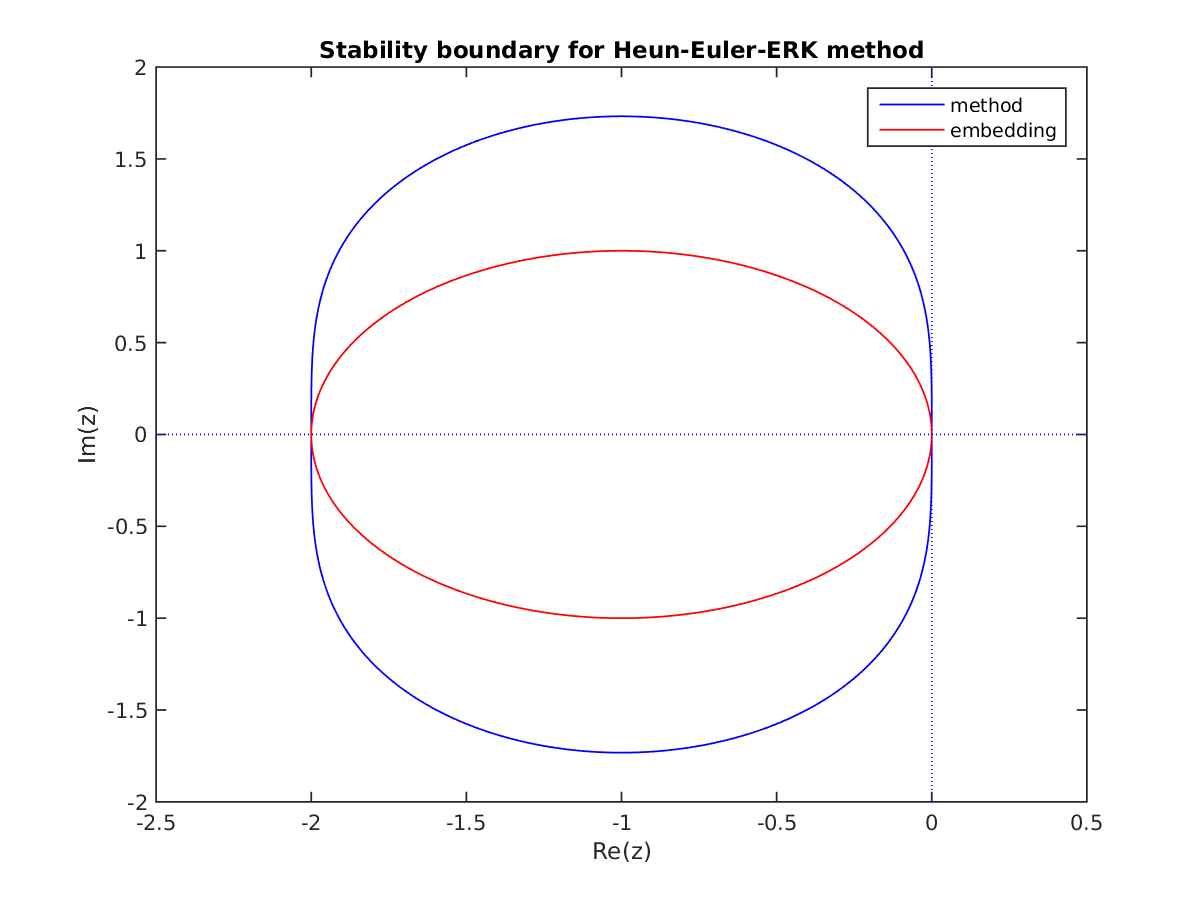
Fig. 2.4 Linear stability region for the Heun-Euler method. The method’s region is outlined in blue; the embedding’s region is in red.
-
enumerator ARKODE_RALSTON_EULER_2_1_2
Accessible via the constant ARKODE_RALSTON_EULER_2_1_2 to
ARKStepSetTableNum(), ERKStepSetTableNum() or
ARKodeButcherTable_LoadERK().
Accessible via the string "ARKODE_RALSTON_EULER_2_1_2" to
ARKStepSetTableName(), ERKStepSetTableName() or
ARKodeButcherTable_LoadERKByName().
(primary method from [119]).

Fig. 2.5 Linear stability region for the Ralston-Euler method. The method’s region is outlined in blue; the embedding’s region is in red.
-
enumerator ARKODE_EXPLICIT_MIDPOINT_EULER_2_1_2
Accessible via the constant ARKODE_EXPLICIT_MIDPOINT_EULER_2_1_2 to
ARKStepSetTableNum(), ERKStepSetTableNum() or
ARKodeButcherTable_LoadERK().
Accessible via the string "ARKODE_EXPLICIT_MIDPOINT_EULER_2_1_2" to
ARKStepSetTableName(), ERKStepSetTableName() or
ARKodeButcherTable_LoadERKByName().
(primary method from [127]).

Fig. 2.6 Linear stability region for the Explicit-Midpoint-Euler method. The method’s region is outlined in blue; the embedding’s region is in red.
-
enumerator ARKODE_SSP_ERK_3_1_2
Accessible via the constant ARKODE_SSP_ERK_3_1_2 to
ARKStepSetTableNum(), ERKStepSetTableNum() or
ARKodeButcherTable_LoadERK().
Accessible via the string "ARKODE_SSP_ERK_3_1_2" to
ARKStepSetTableName(), ERKStepSetTableName() or
ARKodeButcherTable_LoadERKByName().
This is the “SSPERK(3,2)” method from [61].
Both the method and its embedding have optimal SSP coefficient
equal to 2.
Added in version 7.8.0 (6.8.0).

Fig. 2.7 Linear stability region for the SSP-ERK-3-1-2 method. The method’s region is outlined in red; the embedding’s region is in blue dashed.
-
enumerator ARKODE_SSP_ERK_4_1_2
Accessible via the constant ARKODE_SSP_ERK_4_1_2 to
ARKStepSetTableNum(), ERKStepSetTableNum() or
ARKodeButcherTable_LoadERK().
Accessible via the string "ARKODE_SSP_ERK_4_1_2" to
ARKStepSetTableName(), ERKStepSetTableName() or
ARKodeButcherTable_LoadERKByName().
This is the “SSPERK(4,2)” method from [61].
Both the method and its embedding have optimal SSP coefficient
equal to 3.
Added in version 7.8.0 (6.8.0).

Fig. 2.8 Linear stability region for the SSP-ERK-4-1-2 method. The method’s region is outlined in red; the embedding’s region is in blue dashed.
-
enumerator ARKODE_ARK2_ERK_3_1_2
Accessible via the constant ARKODE_ARK2_ERK_3_1_2 to
ARKStepSetTableNum(), ERKStepSetTableNum() or
ARKodeButcherTable_LoadERK().
Accessible via the string "ARKODE_ARK2_ERK_3_1_2" to
ARKStepSetTableName(), ERKStepSetTableName() or
ARKodeButcherTable_LoadERKByName().
This is the explicit portion of the default 2nd order additive method (the
explicit portion of the ARK2 method from [69]).
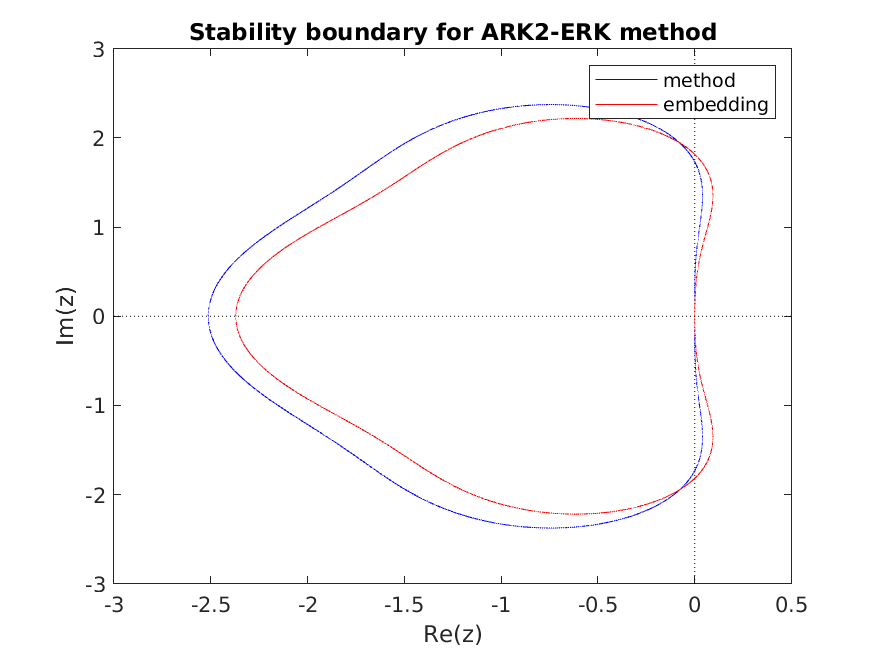
Fig. 2.9 Linear stability region for the ARK2-ERK method. The method’s region is outlined in blue; the embedding’s region is in red.
-
enumerator ARKODE_ASCHER_ERK_3_1_2
Accessible via the constant ARKODE_ASCHER_ERK_3_1_2 to
ARKStepSetTableNum(), ERKStepSetTableNum() or
ARKodeButcherTable_LoadERK().
Accessible via the string "ARKODE_ASCHER_ERK_3_1_2" to
ARKStepSetTableName(), ERKStepSetTableName() or
ARKodeButcherTable_LoadERKByName().
The method is the explicit portion of the “(2,2,2)” additive Runge–Kutta
method from Section 2.6 of [15]; the embedding was invented specifically for
ARKODE.
Added in version 7.8.0 (6.8.0).
where \(\gamma = \frac{2-\sqrt{2}}{2}\) and \(\delta = 1-\frac{1}{2\gamma}\).

Fig. 2.10 Linear stability region for the Ascher-ERK-3-1-2 method. The method’s region is outlined in red; the embedding’s region is in blue dashed.
-
enumerator ARKODE_SSP_LSPUM_ERK_3_1_2
Accessible via the constant ARKODE_SSP_LSPUM_ERK_3_1_2 to
ARKStepSetTableNum(), ERKStepSetTableNum() or
ARKodeButcherTable_LoadERK().
Accessible via the string "ARKODE_SSP_LSPUM_ERK_3_1_2" to
ARKStepSetTableName(), ERKStepSetTableName() or
ARKodeButcherTable_LoadERKByName().
The method is the explicit portion of the “SSP2(3,3,2)-LSPUM” additive
Runge–Kutta method from [80]; the embedding was invented
specifically for ARKODE. The method has SSP coefficient equal to 1.2,
and the embedding has SSP coefficient equal to 1.15.
Added in version 7.8.0 (6.8.0).

Fig. 2.11 Linear stability region for the SSP-LSPUM-ERK-3-1-2 method. The method’s region is outlined in red; the embedding’s region is in blue dashed.
-
enumerator ARKODE_BOGACKI_SHAMPINE_4_2_3
Accessible via the constant ARKODE_BOGACKI_SHAMPINE_4_2_3 to
ARKStepSetTableNum(), ERKStepSetTableNum() or
ARKodeButcherTable_LoadERK().
Accessible via the string "ARKODE_BOGACKI_SHAMPINE_4_2_3" to
ARKStepSetTableName(), ERKStepSetTableName() or
ARKodeButcherTable_LoadERKByName().
This is the default 3rd order
explicit method (from [22]).
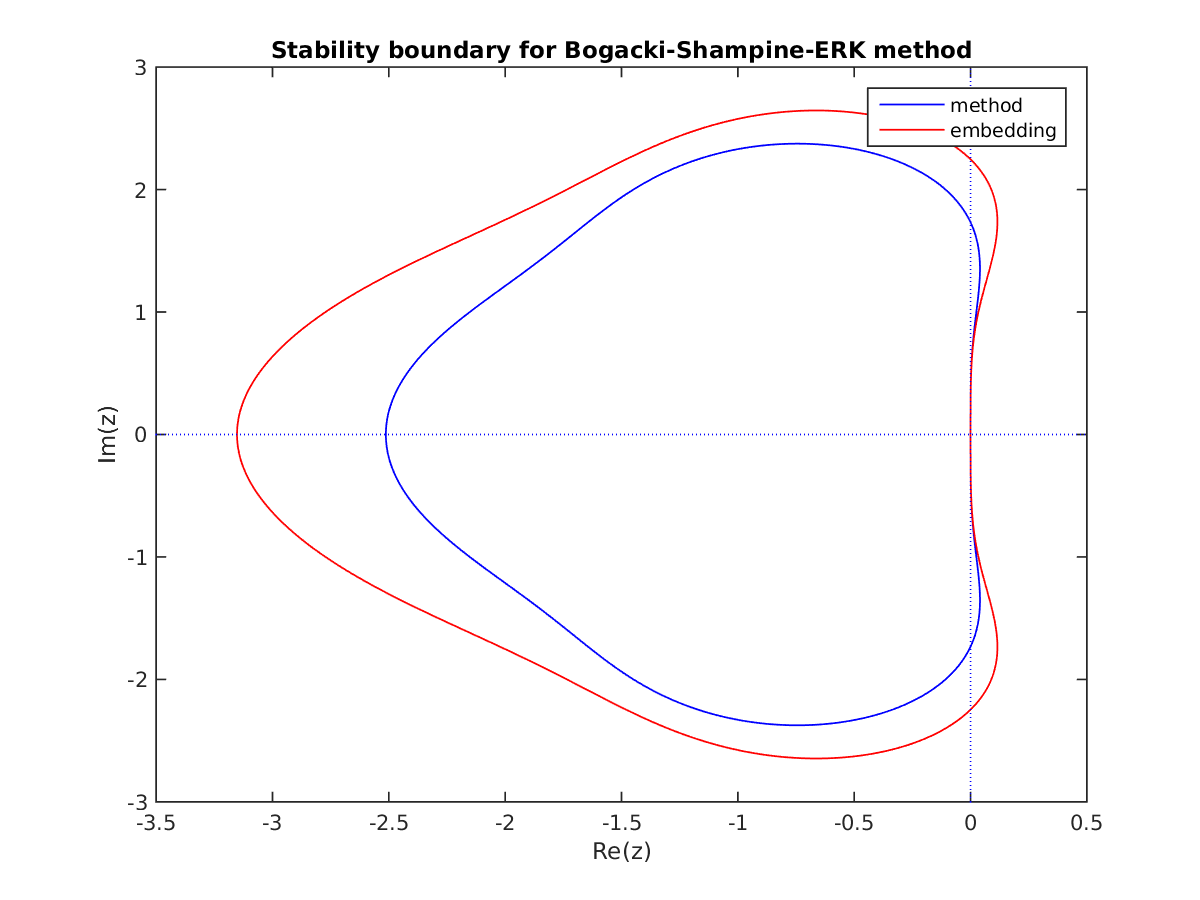
Fig. 2.12 Linear stability region for the Bogacki-Shampine method. The method’s region is outlined in blue; the embedding’s region is in red.
-
enumerator ARKODE_ARK324L2SA_ERK_4_2_3
Accessible via the constant ARKODE_ARK324L2SA_ERK_4_2_3 to
ARKStepSetTableNum(), ERKStepSetTableNum() or
ARKodeButcherTable_LoadERK().
Accessible via the string "ARKODE_ARK324L2SA_ERK_4_2_3" to
ARKStepSetTableName(), ERKStepSetTableName() or
ARKodeButcherTable_LoadERKByName().
This is the explicit portion of
the default 3rd order additive method (the explicit portion of the ARK3(2)4L[2]SA
method from [96]).
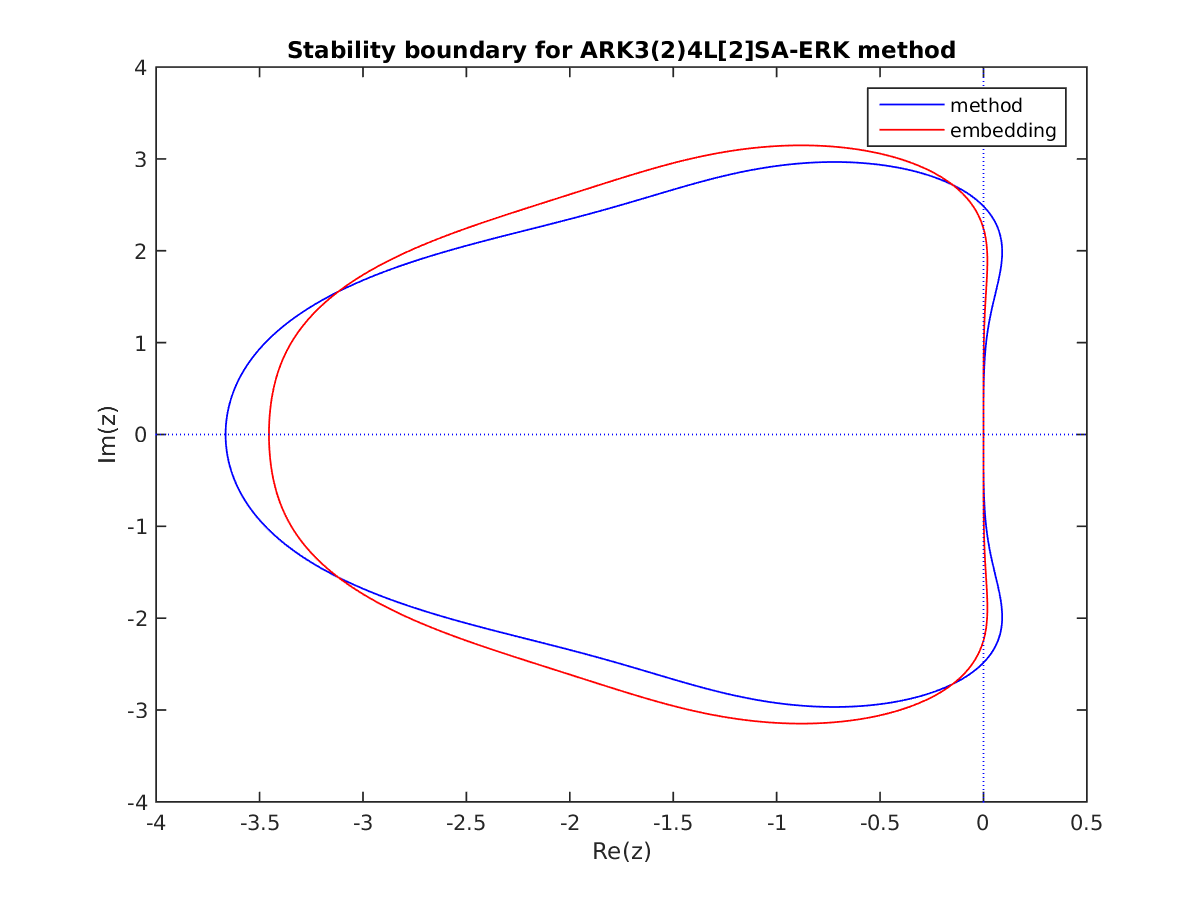
Fig. 2.13 Linear stability region for the explicit ARK-4-2-3 method. The method’s region is outlined in blue; the embedding’s region is in red.
-
enumerator ARKODE_SHU_OSHER_3_2_3
Accessible via the constant ARKODE_SHU_OSHER_3_2_3 to
ARKStepSetTableNum(), ERKStepSetTableNum() or
ARKodeButcherTable_LoadERK().
Accessible via the string "ARKODE_SHU_OSHER_3_2_3" to
ARKStepSetTableName(), ERKStepSetTableName() or
ARKodeButcherTable_LoadERKByName().
(from [142] with embedding from [62]).
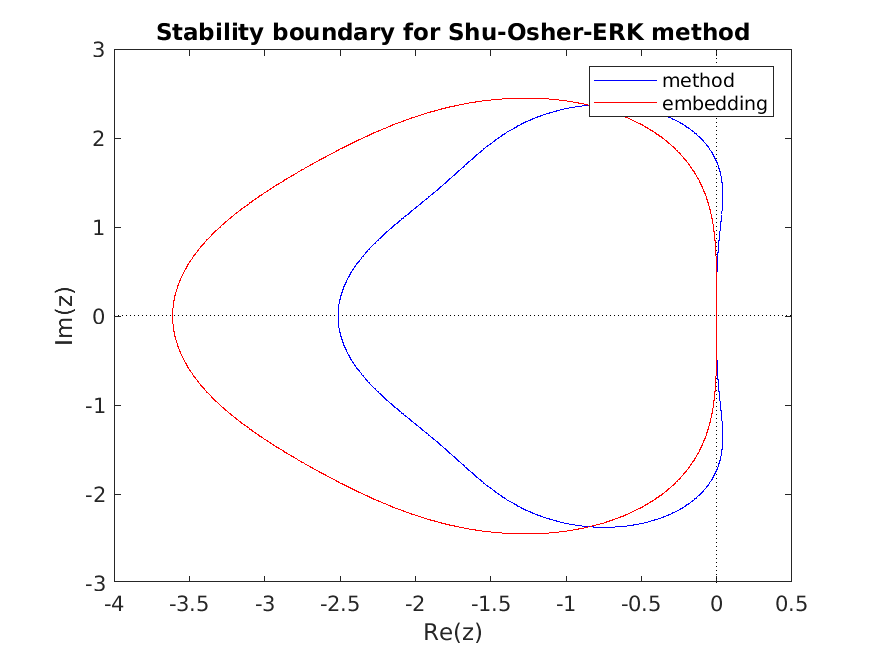
Fig. 2.14 Linear stability region for the Shu-Osher method. The method’s region is outlined in blue; the embedding’s region is in red.
-
enumerator ARKODE_KNOTH_WOLKE_3_3
Accessible via the constant ARKODE_KNOTH_WOLKE_3_3 to
ARKStepSetTableNum(), ERKStepSetTableNum(), or
ARKodeButcherTable_LoadERK().
Accessible via the string "ARKODE_KNOTH_WOLKE_3_3" to
ARKStepSetTableName(), ERKStepSetTableName(), or
ARKodeButcherTable_LoadERKByName().
This is the default 3th order slow and fast MRIStep method (from
[102]).
Warning
When using this non-embedded table, users must specify the
time step by calling ARKodeSetFixedStep().
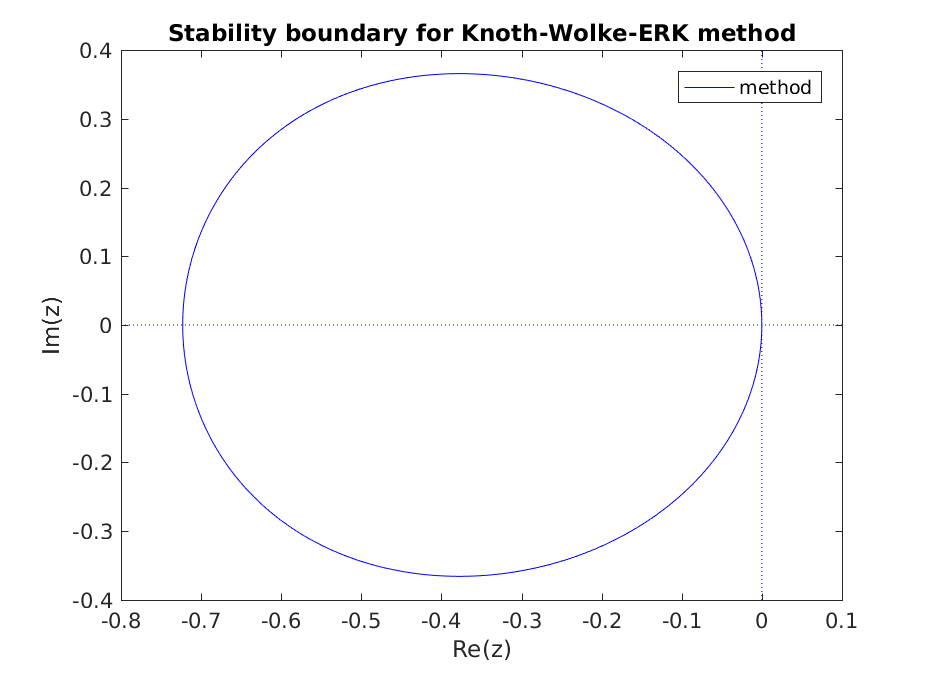
Fig. 2.15 Linear stability region for the Knoth-Wolke method
-
enumerator ARKODE_SSP_ERK_4_2_3
Accessible via the constant ARKODE_SSP_ERK_4_2_3 to
ARKStepSetTableNum(), ERKStepSetTableNum(), or
ARKodeButcherTable_LoadERK().
Accessible via the string "ARKODE_SSP_ERK_4_2_3" to
ARKStepSetTableName(), ERKStepSetTableName(), or
ARKodeButcherTable_LoadERKByName().
This is the “SSPERK(4,3)” method from [61].
Both the method and its embedding have SSP coefficient equal to 2.
Added in version 7.8.0 (6.8.0).

Fig. 2.16 Linear stability region for the SSP-ERK-4-2-3 method. The method’s region is outlined in red; the embedding’s region is in blue dashed.
-
enumerator ARKODE_SSP_ERK_10_3_4
Accessible via the constant ARKODE_SSP_ERK_10_3_4 to
ARKStepSetTableNum(), ERKStepSetTableNum(), or
ARKodeButcherTable_LoadERK().
Accessible via the string "ARKODE_SSP_ERK_10_3_4" to
ARKStepSetTableName(), ERKStepSetTableName(), or
ARKodeButcherTable_LoadERKByName().
This is the “SSPERK(10,4)” method from [61].
The method has SSP coefficient equal to 6.
Added in version 7.8.0 (6.8.0).

Fig. 2.17 Linear stability region for the SSP-ERK-10-3-4 method. The method’s region is outlined in red; the embedding’s region is in blue dashed.
-
enumerator ARKODE_SOFRONIOU_SPALETTA_5_3_4
Accessible via the constant ARKODE_SOFRONIOU_SPALETTA_5_3_4 to
ARKStepSetTableNum(), ERKStepSetTableNum()
or ARKodeButcherTable_LoadERK().
Accessible via the string "ARKODE_SOFRONIOU_SPALETTA_5_3_4" to
ARKStepSetTableName(), ERKStepSetTableName() or
ARKodeButcherTable_LoadERKByName().
This is the default 4th order explicit method.
(from [147]).
Changed in version 7.3.0 (ARKODE 6.3.0): Made the default 4th order explicit method
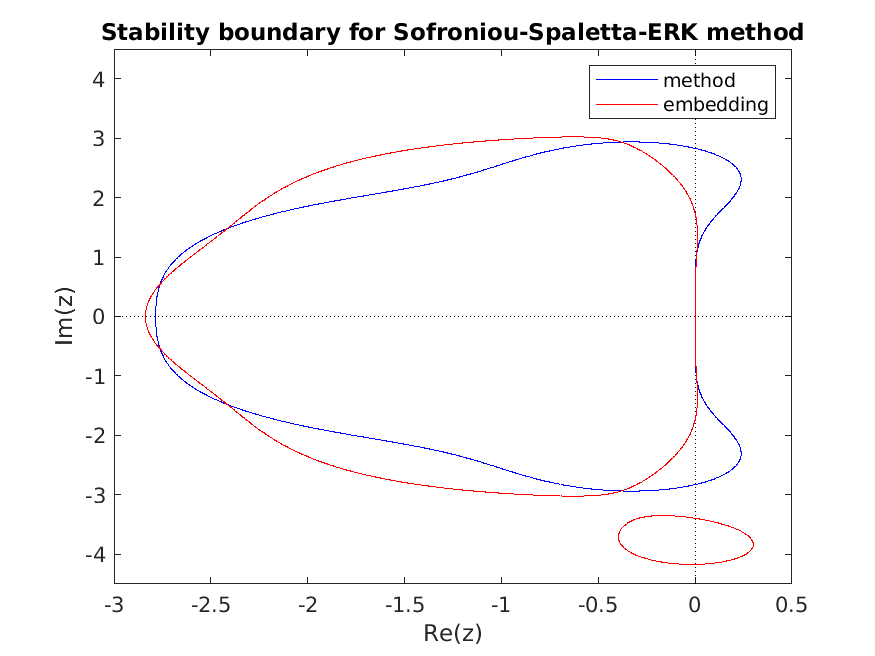
Fig. 2.18 Linear stability region for the Sofroniou-Spaletta method. The method’s region is outlined in blue; the embedding’s region is in red.
-
enumerator ARKODE_ZONNEVELD_5_3_4
Accessible via the constant ARKODE_ZONNEVELD_5_3_4 to
ARKStepSetTableNum(), ERKStepSetTableNum(), or
ARKodeButcherTable_LoadERK().
Accessible via the string "ARKODE_ZONNEVELD_5_3_4" to
ARKStepSetTableName(), ERKStepSetTableName(), or
ARKodeButcherTable_LoadERKByName().
(from [169]).
Changed in version 7.3.0 (ARKODE 6.3.0): Replaced by ARKODE_SOFRONIOU_SPALETTA_5_3_4 as the default 4th order explicit method
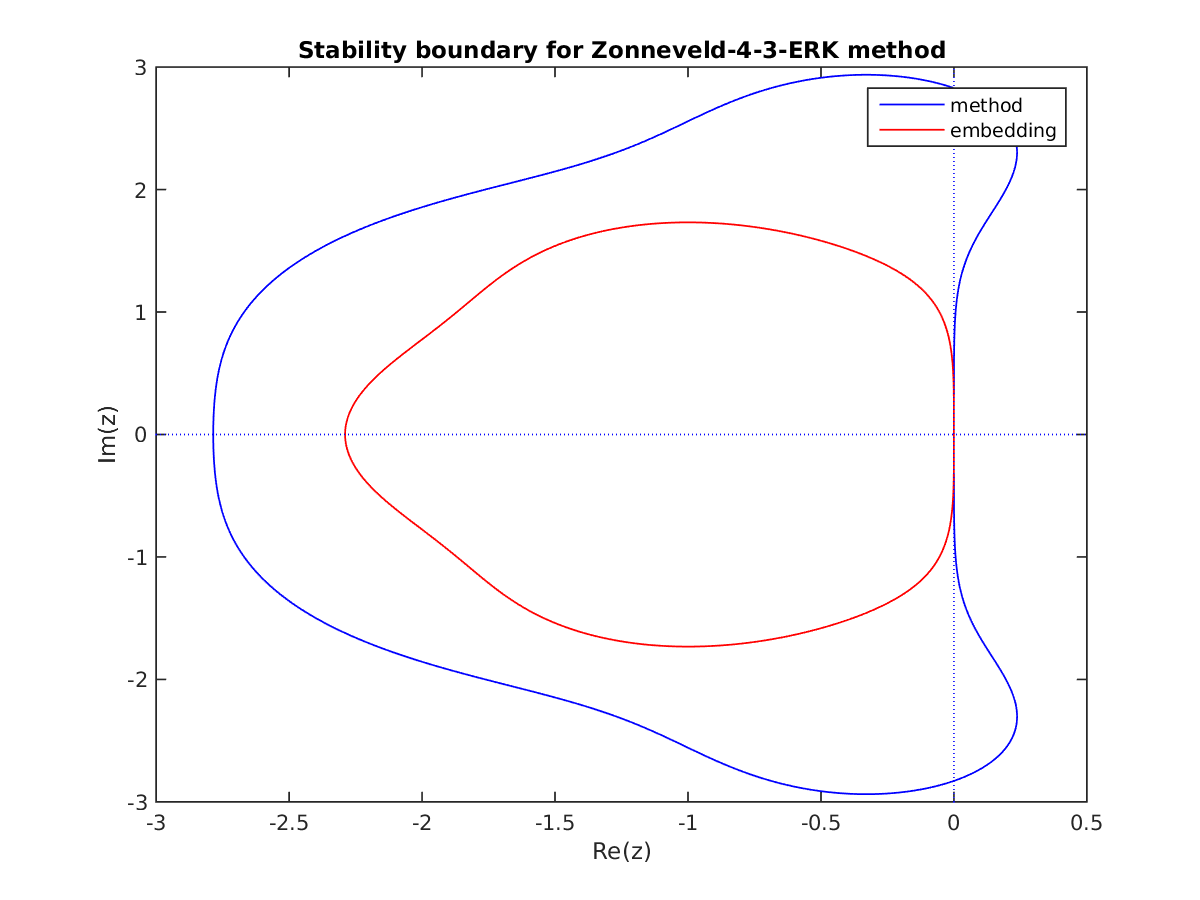
Fig. 2.19 Linear stability region for the Zonneveld method. The method’s region is outlined in blue; the embedding’s region is in red.
-
enumerator ARKODE_ARK436L2SA_ERK_6_3_4
Accessible via the constant ARKODE_ARK436L2SA_ERK_6_3_4 to
ARKStepSetTableNum(), ERKStepSetTableNum()
or ARKodeButcherTable_LoadERK().
Accessible via the string "ARKODE_ARK436L2SA_ERK_6_3_4" to
ARKStepSetTableName(), ERKStepSetTableName() or
ARKodeButcherTable_LoadERKByName().
This is the explicit portion of the ARK4(3)6L[2]SA method from
[96].
Changed in version 7.3.0 (ARKODE 6.3.0): Replaced by ARKODE_ARK437L2SA_ERK_7_3_4 as the explicit portion of the default 4th order additive method
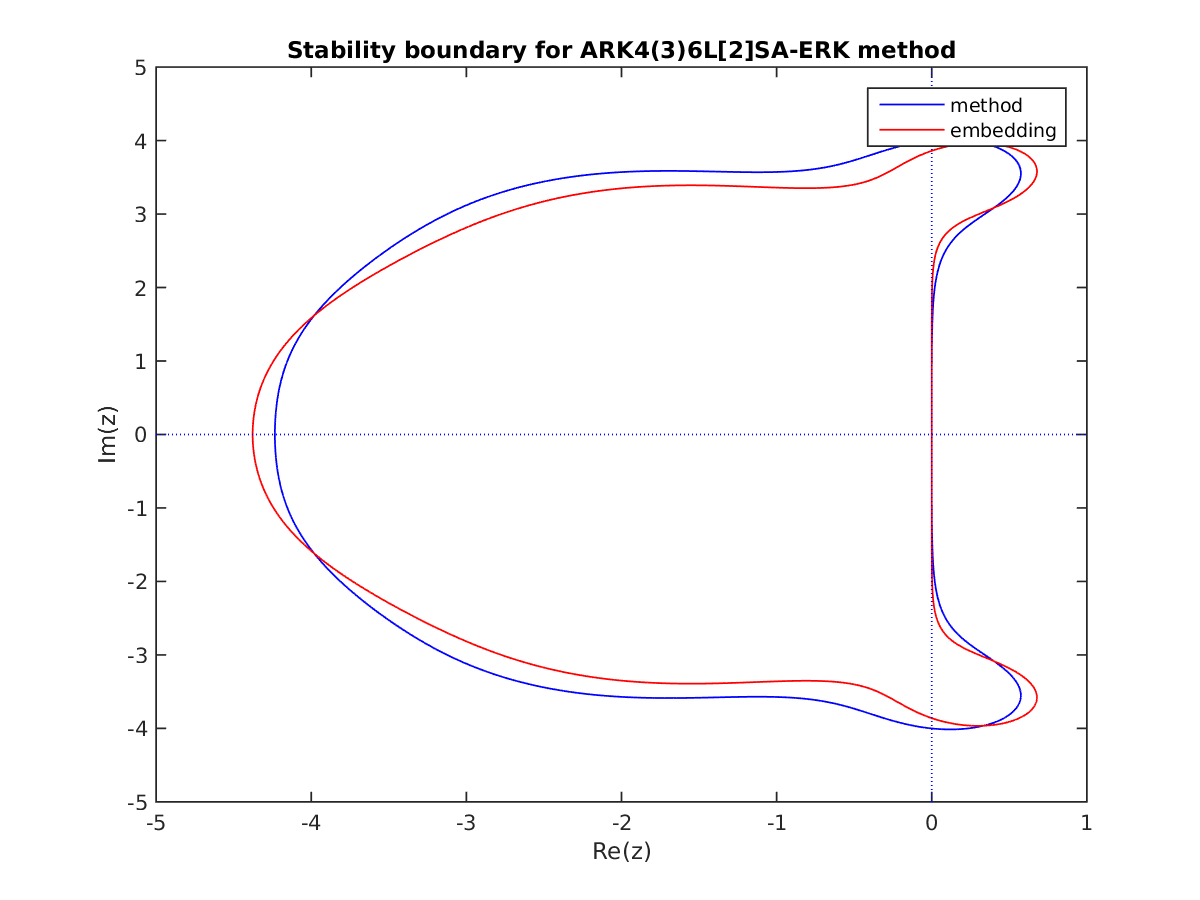
Fig. 2.20 Linear stability region for the ARK436L2SA-ERK-6-3-4 method. The method’s region is outlined in blue; the embedding’s region is in red.
-
enumerator ARKODE_ARK437L2SA_ERK_7_3_4
Accessible via the constant ARKODE_ARK437L2SA_ERK_7_3_4 to
ARKStepSetTableNum(), ERKStepSetTableNum()
or ARKodeButcherTable_LoadERK().
Accessible via the string "ARKODE_ARK437L2SA_ERK_7_3_4" to
ARKStepSetTableName(), ERKStepSetTableName() or
ARKodeButcherTable_LoadERKByName().
This is the explicit portion of the default 4th order additive method and the
explicit portion of the ARK4(3)7L[2]SA method from [99].
Changed in version 7.3.0 (ARKODE 6.3.0): Made the explicit portion of the default 4th order additive method
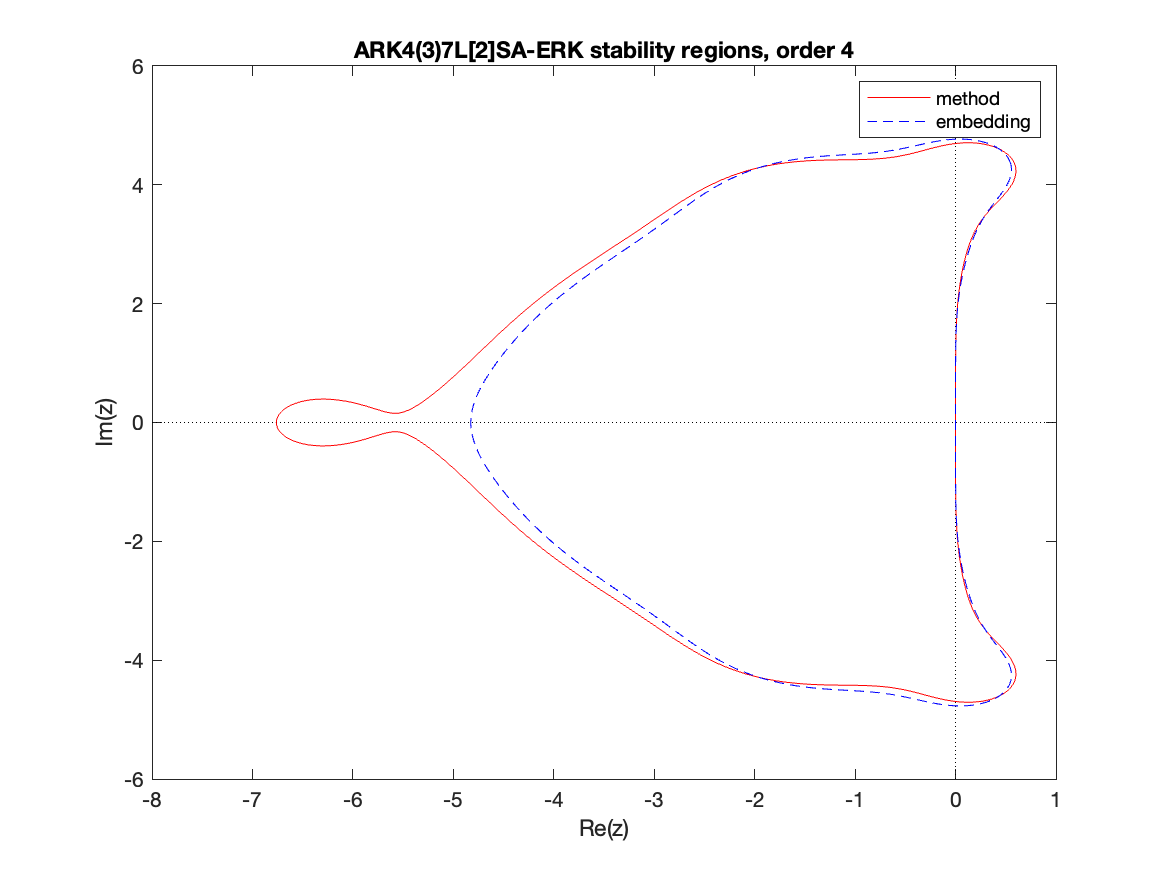
Fig. 2.21 Linear stability region for the ARK437L2SA-ERK-7-3-4 method. The method’s region is outlined in blue; the embedding’s region is in red.
-
enumerator ARKODE_SAYFY_ABURUB_6_3_4
Accessible via the constant ARKODE_SAYFY_ABURUB_6_3_4 to
ARKStepSetTableNum(), ERKStepSetTableNum()
or ARKodeButcherTable_LoadERK().
Accessible via the string "ARKODE_SAYFY_ABURUB_6_3_4" to
ARKStepSetTableName(), ERKStepSetTableName() or
ARKodeButcherTable_LoadERKByName().
(from [133]).
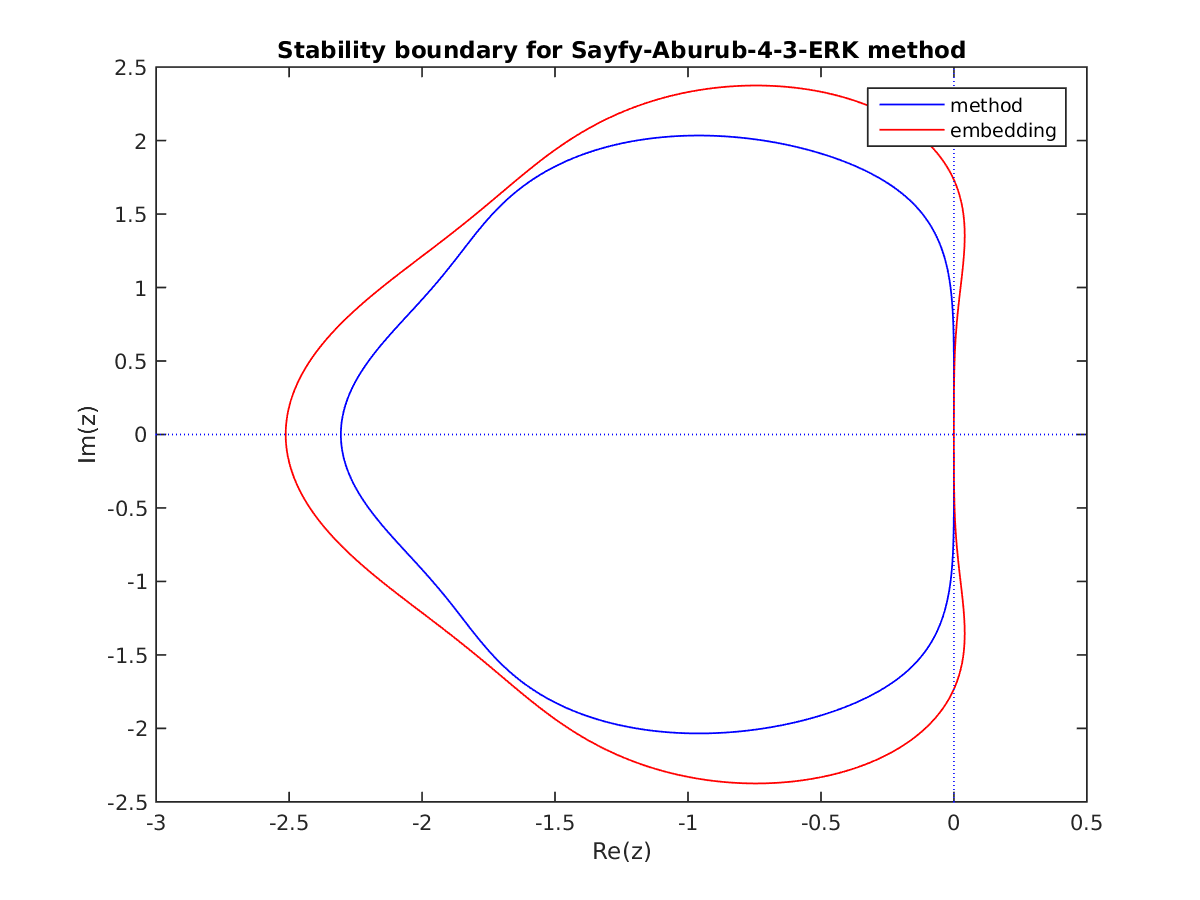
Fig. 2.22 Linear stability region for the Sayfy-Aburub-6-3-4 method. The method’s region is outlined in blue; the embedding’s region is in red.
-
enumerator ARKODE_TSITOURAS_7_4_5
Accessible via the constant ARKODE_TSITOURAS_7_4_5 to
ARKStepSetTableNum(), ERKStepSetTableNum()
or ARKodeButcherTable_LoadERK().
Accessible via the string "ARKODE_TSITOURAS_7_4_5" to
ARKStepSetTableName(), ERKStepSetTableName() or
ARKodeButcherTable_LoadERKByName().
This is the default 5th order explicit method (from [161]).
Changed in version 7.3.0 (ARKODE 6.3.0): Added as the default 5th order explicit method
Warning
The embedded coefficients do not match Table 1 in [161] due to typographical errors in the paper. The correct coefficients are derived using the Mathematica code provided in the appendix of [161] after correcting the last embedded coefficient from \(\frac{1}{40}\) to \(\frac{1}{66}\).

Fig. 2.23 Linear stability region for the Tsitouras method. The method’s region is outlined in blue; the embedding’s region is in red.
-
enumerator ARKODE_CASH_KARP_6_4_5
Accessible via the constant ARKODE_CASH_KARP_6_4_5 to
ARKStepSetTableNum(), ERKStepSetTableNum()
or ARKodeButcherTable_LoadERK().
Accessible via the string "ARKODE_CASH_KARP_6_4_5" to
ARKStepSetTableName(), ERKStepSetTableName() or
ARKodeButcherTable_LoadERKByName().
(from [39]).
Changed in version 7.3.0 (ARKODE 6.3.0): Replaced by ARKODE_TSITOURAS_7_4_5 as the default 5th order explicit method
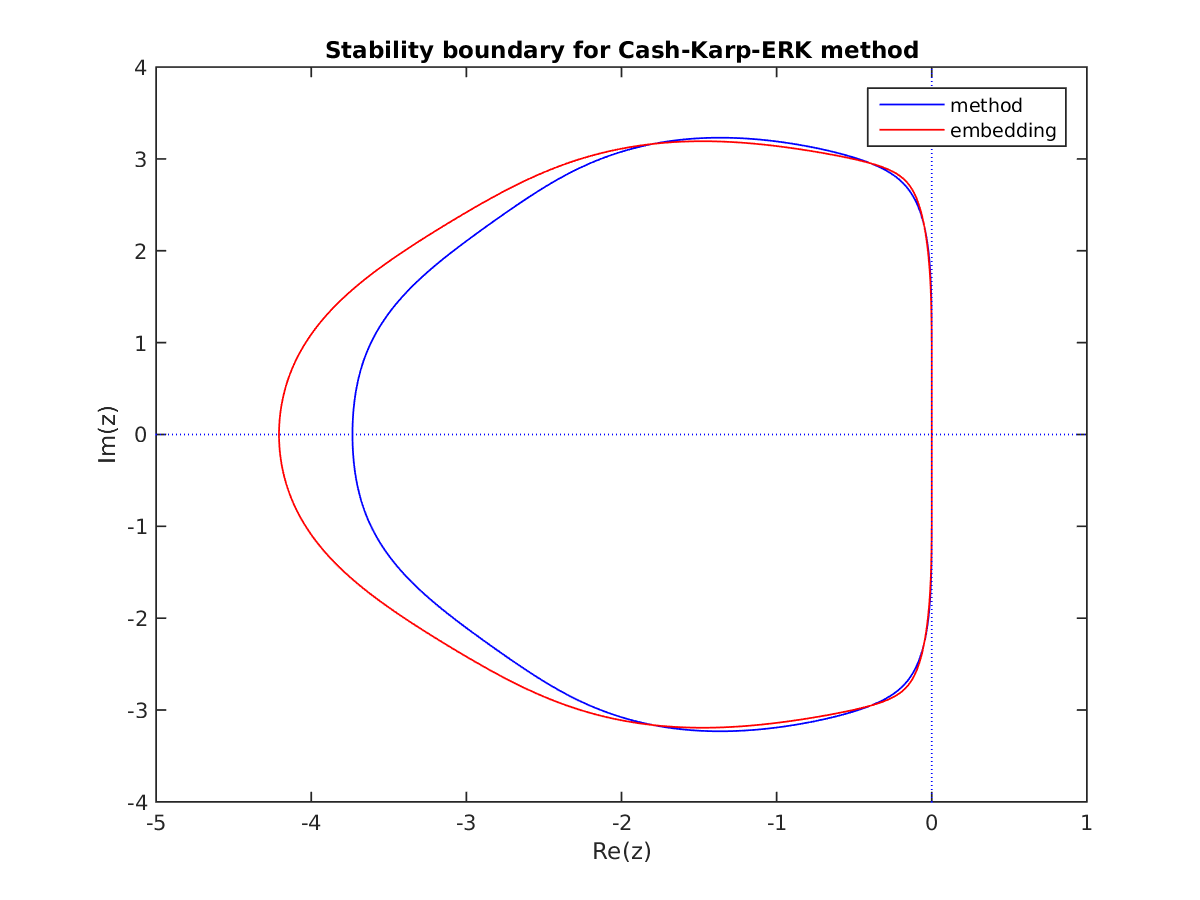
Fig. 2.24 Linear stability region for the Cash-Karp method. The method’s region is outlined in blue; the embedding’s region is in red.
-
enumerator ARKODE_FEHLBERG_6_4_5
Accessible via the constant ARKODE_FEHLBERG_6_4_5 to
ARKStepSetTableNum(), ERKStepSetTableNum()
or ARKodeButcherTable_LoadERK().
Accessible via the string "ARKODE_FEHLBERG_6_4_5" to
ARKStepSetTableName(), ERKStepSetTableName() or
ARKodeButcherTable_LoadERKByName().
(from [60]).
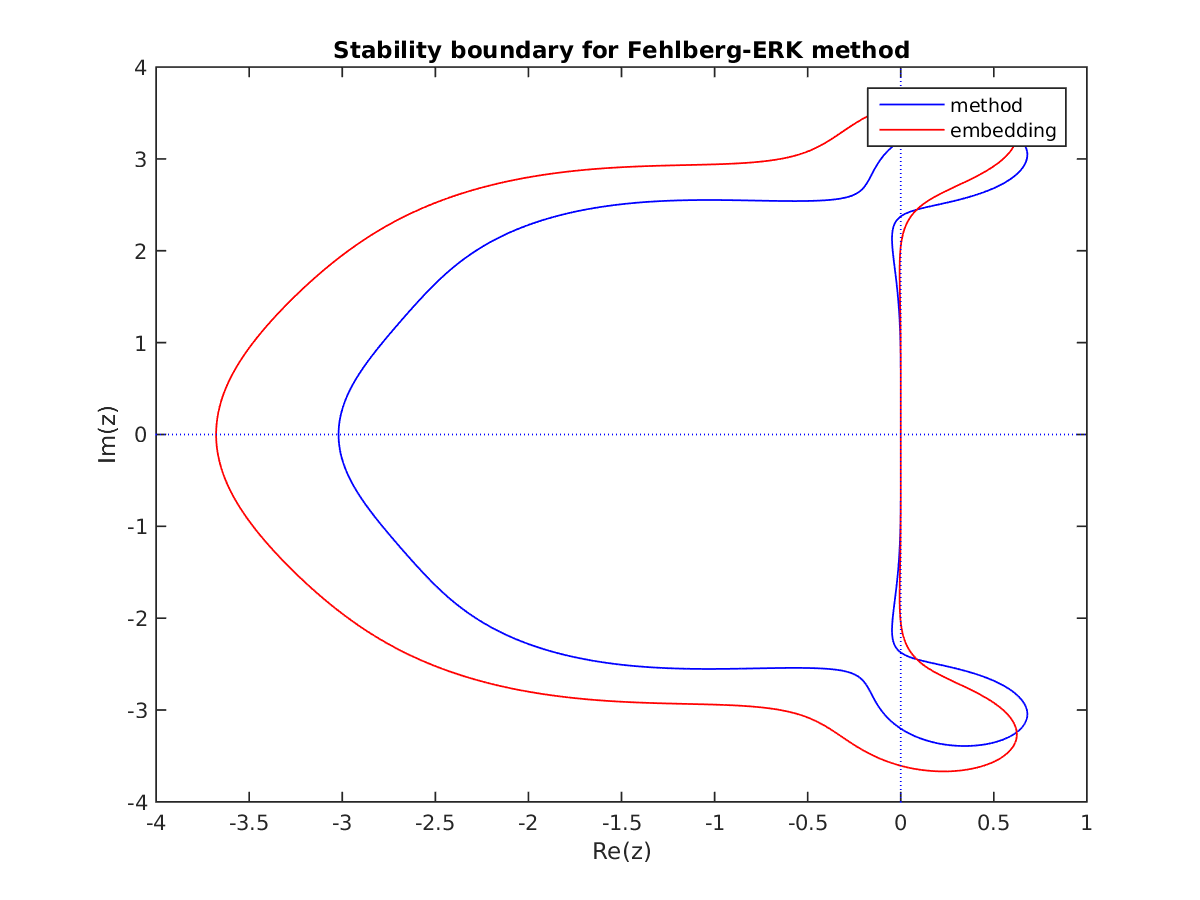
Fig. 2.25 Linear stability region for the Fehlberg method. The method’s region is outlined in blue; the embedding’s region is in red.
-
enumerator ARKODE_DORMAND_PRINCE_7_4_5
Accessible via the constant ARKODE_DORMAND_PRINCE_7_4_5 to
ARKStepSetTableNum(), ERKStepSetTableNum()
or ARKodeButcherTable_LoadERK().
Accessible via the string "ARKODE_DORMAND_PRINCE_7_4_5" to
ARKStepSetTableName(), ERKStepSetTableName() or
ARKodeButcherTable_LoadERKByName().
(from [50]).
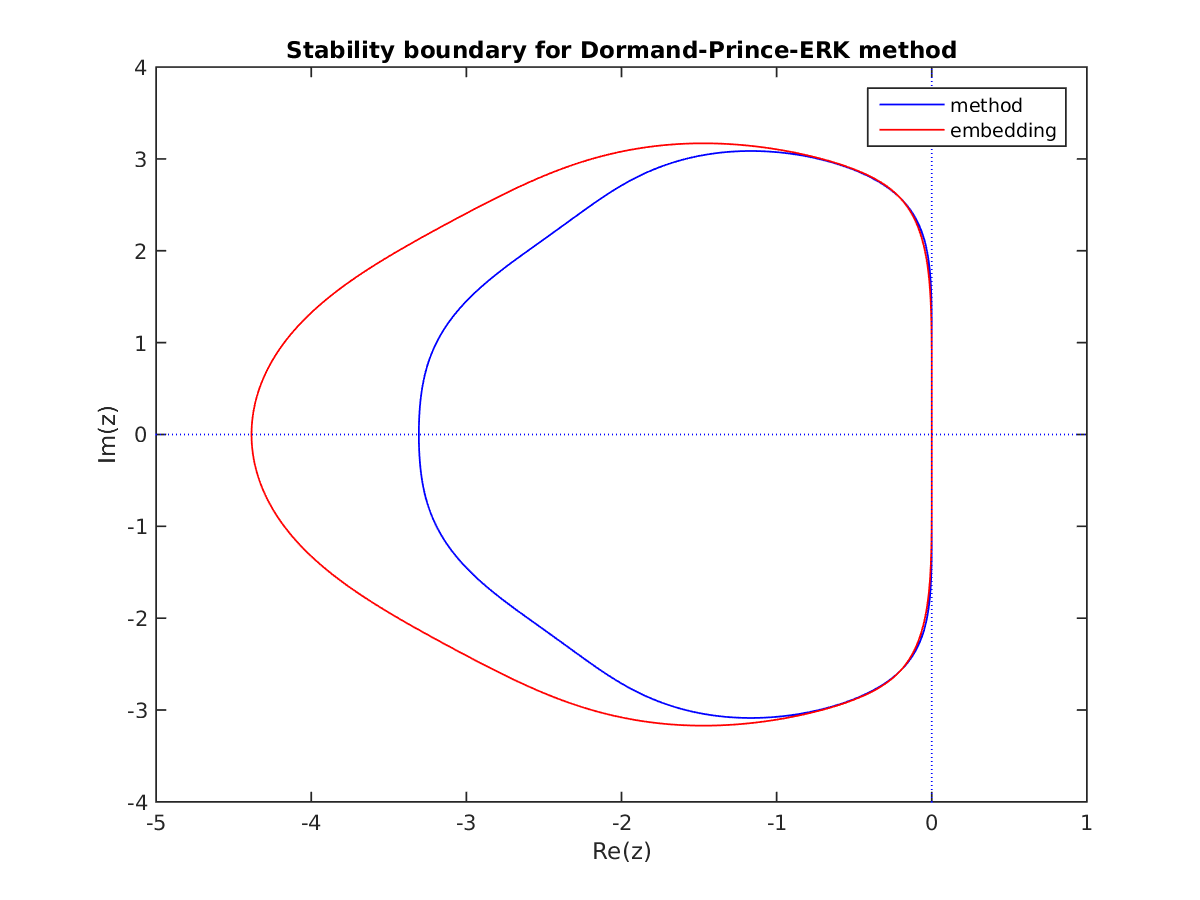
Fig. 2.26 Linear stability region for the Dormand-Prince method. The method’s region is outlined in blue; the embedding’s region is in red.
-
enumerator ARKODE_ARK548L2SA_ERK_8_4_5
Accessible via the constant ARKODE_ARK548L2SA_ERK_8_4_5 to
ARKStepSetTableNum(), ERKStepSetTableNum()
or ARKodeButcherTable_LoadERK().
Accessible via the string "ARKODE_ARK548L2SA_ERK_8_4_5" to
ARKStepSetTableName(), ERKStepSetTableName() or
ARKodeButcherTable_LoadERKByName().
This is the explicit portion of the ARK5(4)8L[2]SA method from
[96].
Changed in version 7.3.0 (ARKODE 6.3.0): Replaced by ARKODE_ARK548L2SAb_ERK_8_4_5 as the explicit portion of the default 5th order additive method
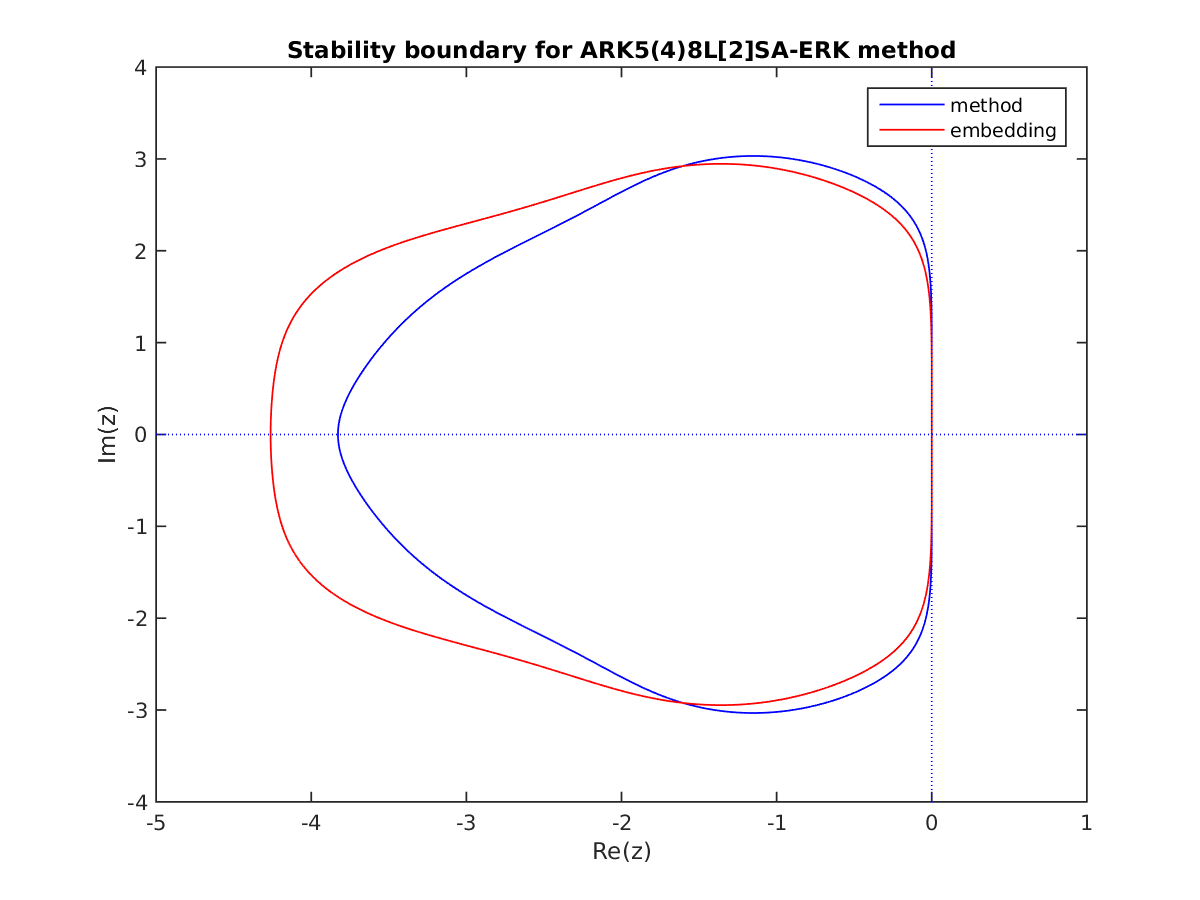
Fig. 2.27 Linear stability region for the explicit ARK-8-4-5 method. The method’s region is outlined in blue; the embedding’s region is in red.
-
enumerator ARKODE_ARK548L2SAb_ERK_8_4_5
Accessible via the constant ARKODE_ARK548L2SAb_ERK_8_4_5 to
ARKStepSetTableNum(), ERKStepSetTableNum()
or ARKodeButcherTable_LoadERK().
Accessible via the string "ARKODE_ARK548L2SAb_ERK_8_4_5" to
ARKStepSetTableName(), ERKStepSetTableName() or
ARKodeButcherTable_LoadERKByName().
This is the explicit portion of the default 5th order additive method and the
explicit portion of the 5th order ARK5(4)8L[2]SA method from
[99].
Changed in version 7.3.0 (ARKODE 6.3.0): Made the explicit portion of the default 5th order additive method
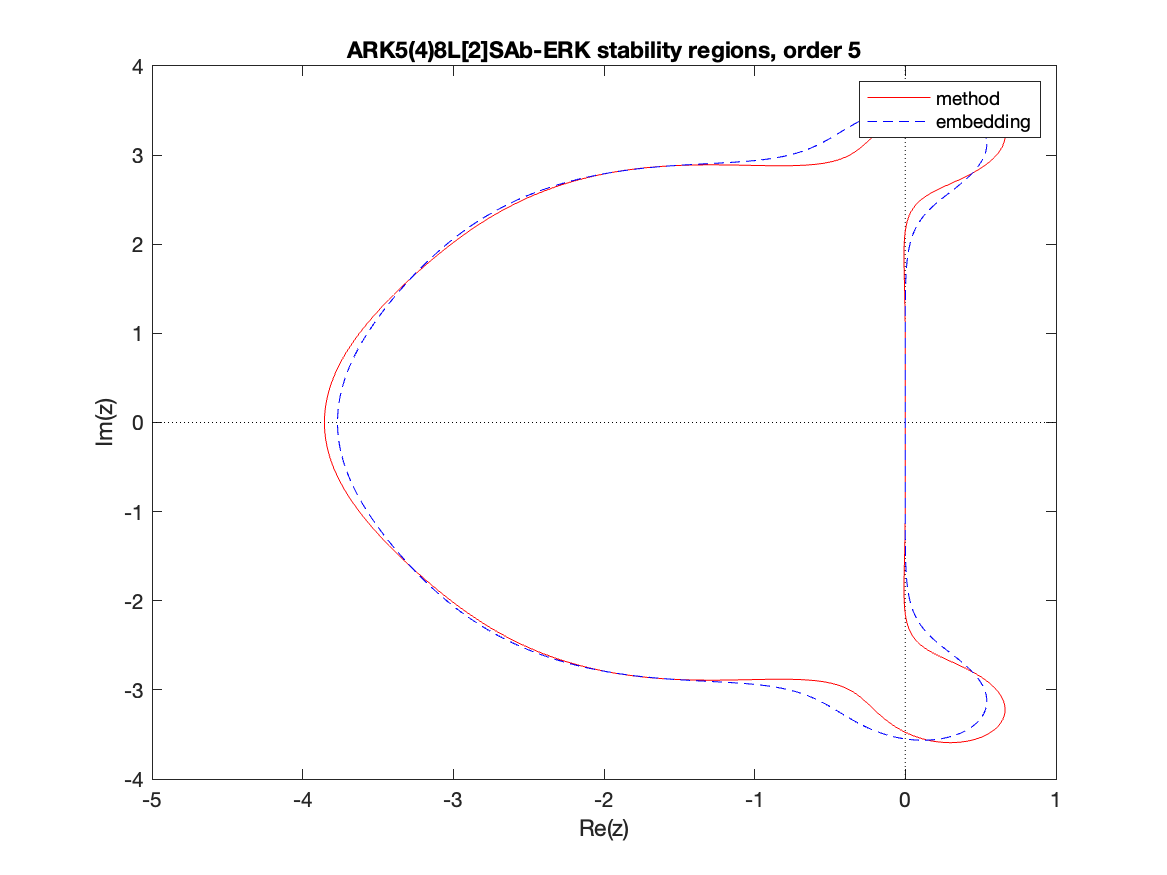
Fig. 2.28 Linear stability region for the ARK548L2SAb-ERK-8-4-5 method. The method’s region is outlined in blue; the embedding’s region is in red.
-
enumerator ARKODE_VERNER_9_5_6
Accessible via the constant ARKODE_VERNER_9_5_6 to
ARKStepSetTableNum(), ERKStepSetTableNum()
or ARKodeButcherTable_LoadERK().
Accessible via the string "ARKODE_VERNER_9_5_6" to
ARKStepSetTableName(), ERKStepSetTableName() or
ARKodeButcherTable_LoadERKByName().
This is the default 6th order explicit method
(method IIIXb-6(5) from [162]).
Changed in version 7.3.0 (ARKODE 6.3.0): Made the default 6th order explicit method
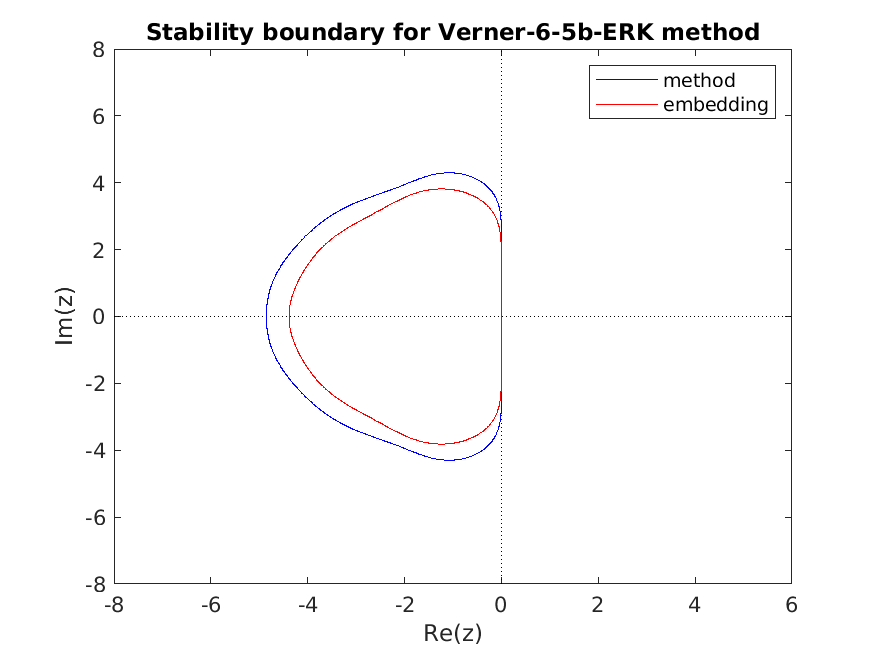
Fig. 2.29 Linear stability region for the Verner-9-5-6 method. The method’s region is outlined in blue; the embedding’s region is in red.
-
enumerator ARKODE_VERNER_8_5_6
Accessible via the constant ARKODE_VERNER_8_5_6 to
ARKStepSetTableNum(), ERKStepSetTableNum()
or ARKodeButcherTable_LoadERK().
Accessible via the string "ARKODE_VERNER_8_5_6" to
ARKStepSetTableName(), ERKStepSetTableName() or
ARKodeButcherTable_LoadERKByName().
(from [90]).
Changed in version 7.3.0 (ARKODE 6.3.0): Replaced by ARKODE_VERNER_9_5_6 as the default 6th order explicit method
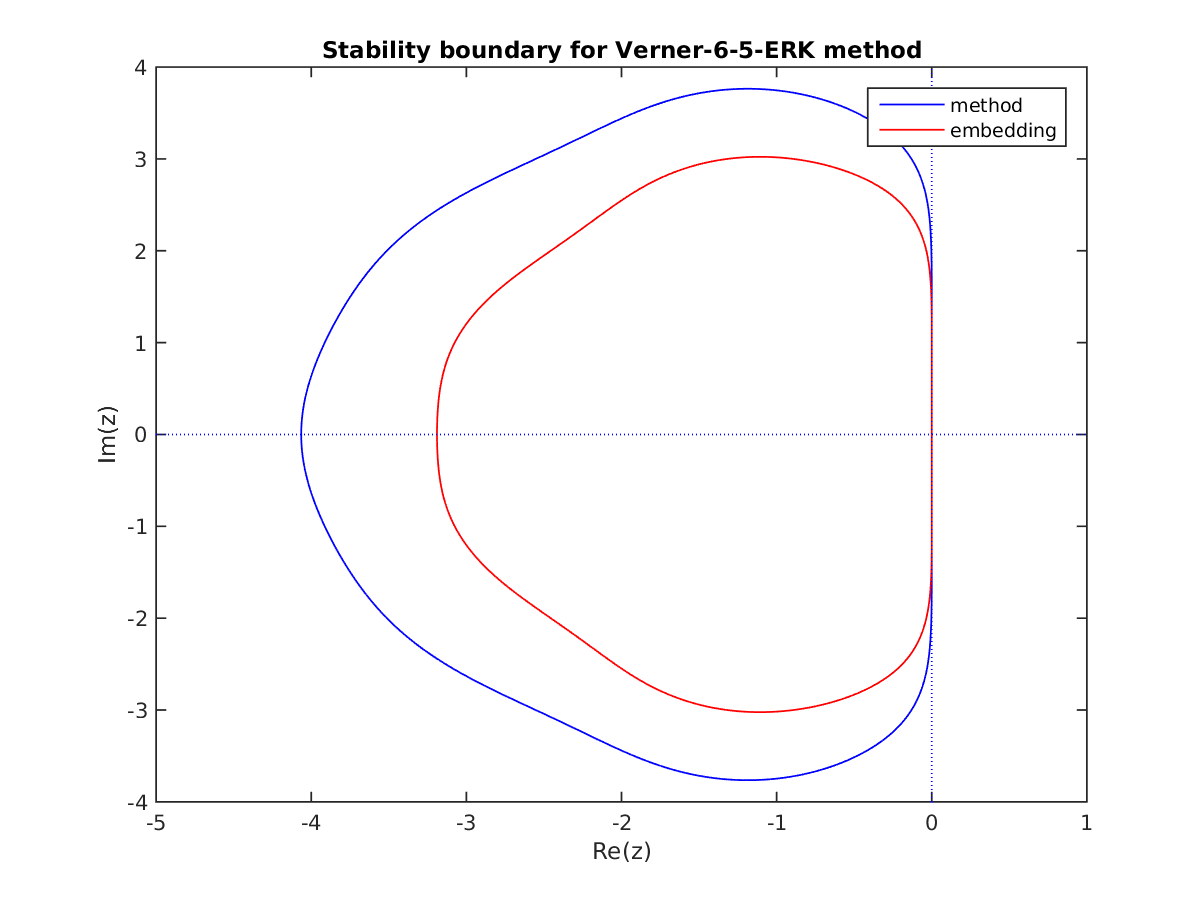
Fig. 2.30 Linear stability region for the Verner-8-5-6 method. The method’s region is outlined in blue; the embedding’s region is in red.
-
enumerator ARKODE_VERNER_10_6_7
Accessible via the constant ARKODE_VERNER_10_6_7 to
ARKStepSetTableNum(), ERKStepSetTableNum()
or ARKodeButcherTable_LoadERK().
Accessible via the string "ARKODE_VERNER_10_6_7" to
ARKStepSetTableName(), ERKStepSetTableName() or
ARKodeButcherTable_LoadERKByName().
This is the default 7th order explicit method (from [162]).
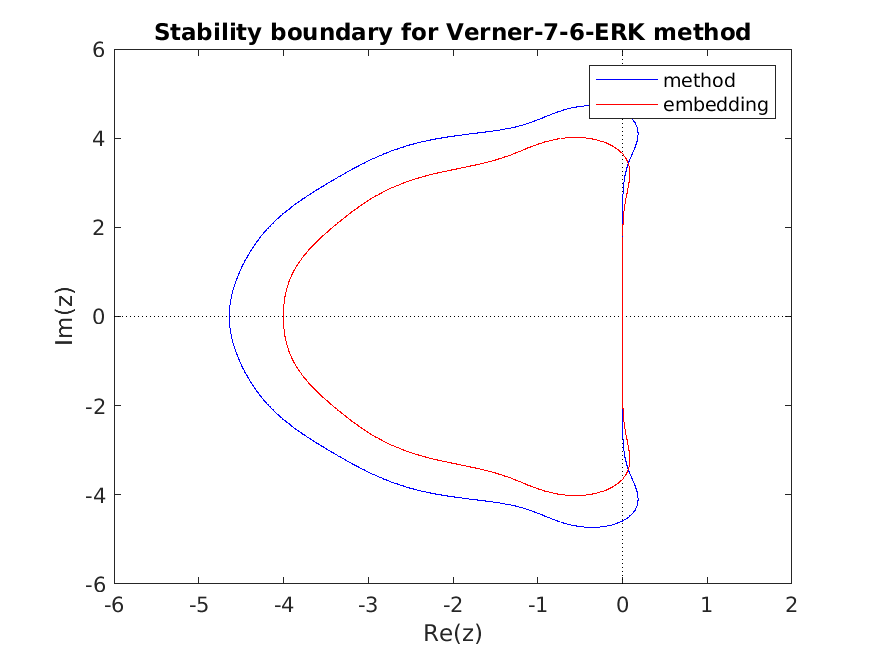
Fig. 2.31 Linear stability region for the Verner-10-6-7 method. The method’s region is outlined in blue; the embedding’s region is in red.
-
enumerator ARKODE_VERNER_13_7_8
Accessible via the constant ARKODE_VERNER_13_7_8 to
ARKStepSetTableNum(), ERKStepSetTableNum()
or ARKodeButcherTable_LoadERK().
Accessible via the string "ARKODE_VERNER_13_7_8" to
ARKStepSetTableName(), ERKStepSetTableName() or
ARKodeButcherTable_LoadERKByName().
This is the default 8th order explicit method
(method IIIX-8(7) from [162]).
Changed in version 7.3.0 (ARKODE 6.3.0): Made the default 8th order explicit method
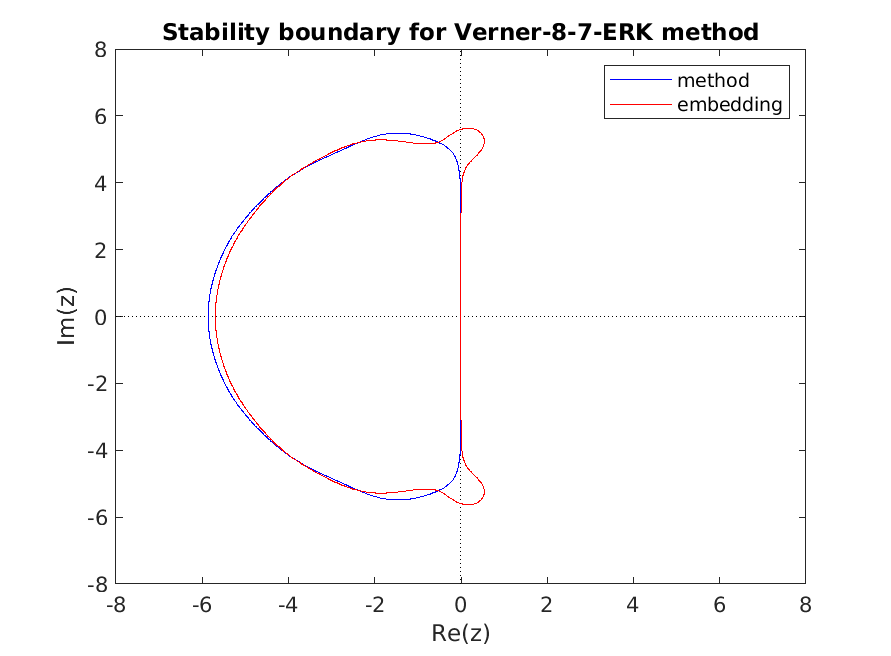
Fig. 2.32 Linear stability region for the Verner-13-7-8 method. The method’s region is outlined in blue; the embedding’s region is in red.
-
enumerator ARKODE_FEHLBERG_13_7_8
Accessible via the constant ARKODE_FEHLBERG_13_7_8 to
ARKStepSetTableNum(), ERKStepSetTableNum()
or ARKodeButcherTable_LoadERK().
Accessible via the string "ARKODE_FEHLBERG_13_7_8" to
ARKStepSetTableName(), ERKStepSetTableName() or
ARKodeButcherTable_LoadERKByName().
(from [30]).
Changed in version 7.3.0 (ARKODE 6.3.0): Replaced by ARKODE_VERNER_13_7_8 as the default 8th order explicit method
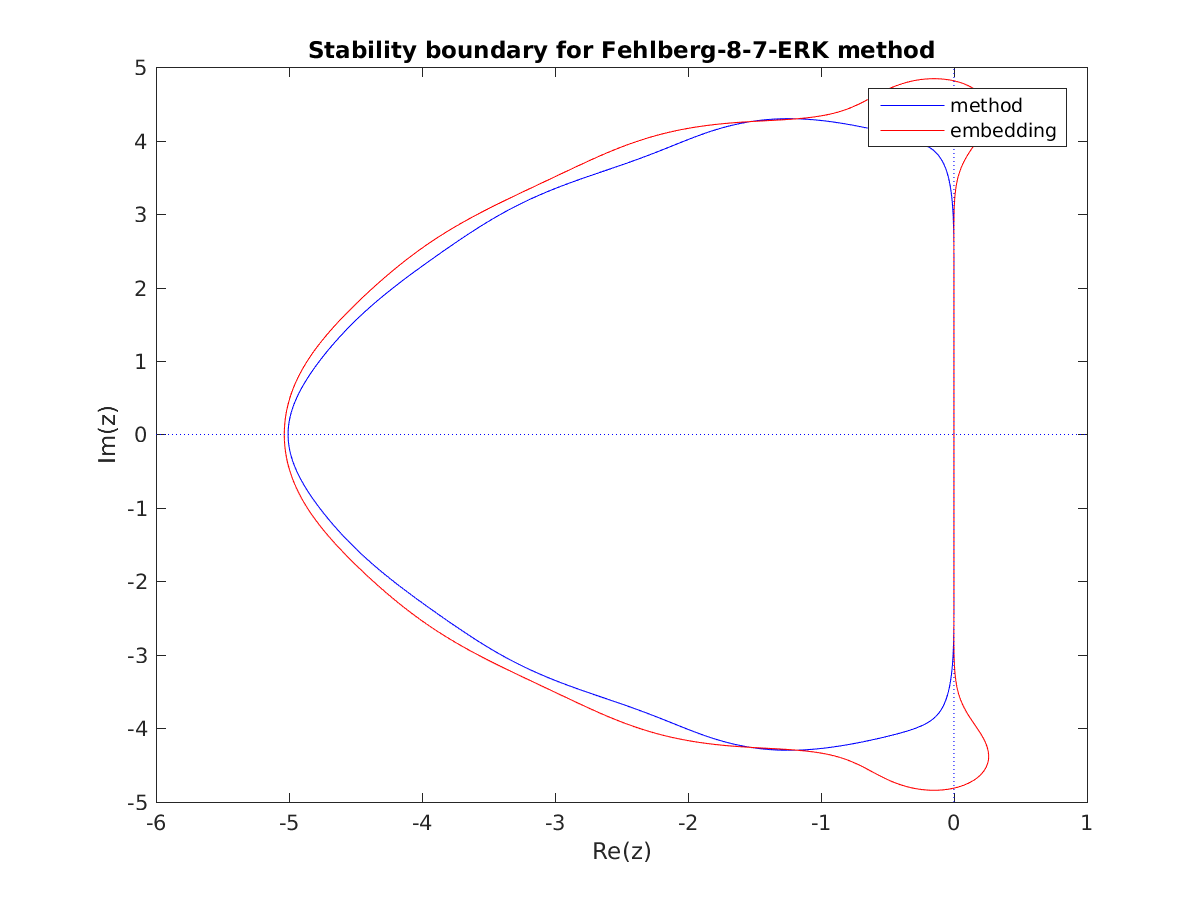
Fig. 2.33 Linear stability region for the Fehlberg-13-7-8 method. The method’s region is outlined in blue; the embedding’s region is in red.
-
enumerator ARKODE_VERNER_16_8_9
Accessible via the constant ARKODE_VERNER_16_8_9 to
ARKStepSetTableNum(), ERKStepSetTableNum()
or ARKodeButcherTable_LoadERK().
Accessible via the string "ARKODE_VERNER_16_8_9" to
ARKStepSetTableName(), ERKStepSetTableName() or
ARKodeButcherTable_LoadERKByName().
This is the default 9th order explicit method (from [162]).
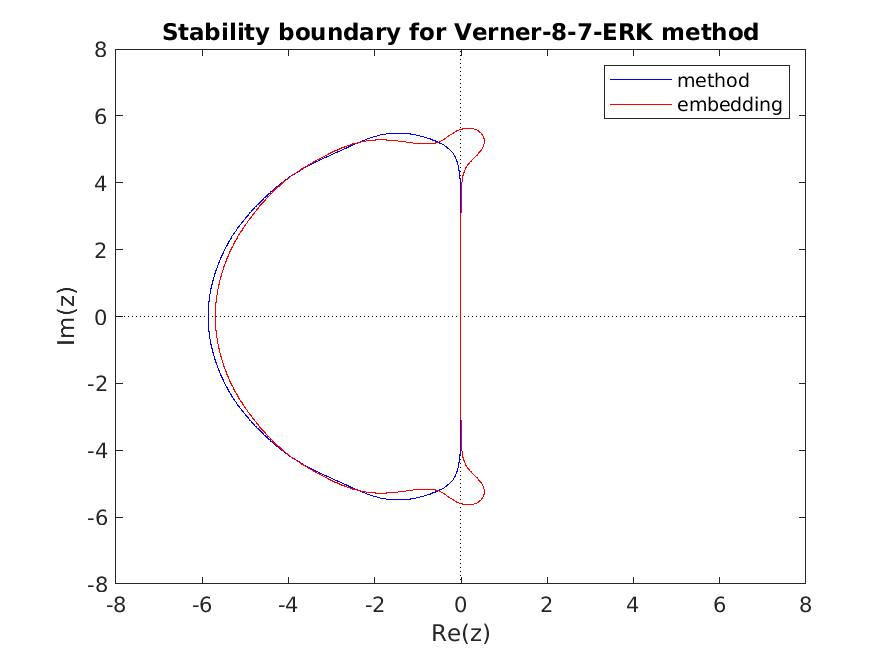
Fig. 2.34 Linear stability region for the Verner-16-8-9 method. The method’s region is outlined in blue; the embedding’s region is in red.
2.8.2. Implicit Butcher tables
In the category of diagonally implicit Runge–Kutta methods, ARKODE includes methods that have orders 2 through 5, with embeddings that are of orders 1 through 4. ARKODE’s diagonally-implicit Butcher tables are provided in the enumeration
-
enum ARKODE_DIRKTableID
with values specified in Table 2.18.
Method ID |
Stages |
Embedded Order |
Order |
|---|---|---|---|
1 |
— |
1* |
|
3 |
1 |
2* |
|
2 |
1 |
2 |
|
3 |
1 |
2 |
|
3 |
1 |
2 |
|
3 |
1 |
2 |
|
1 |
— |
2 |
|
2 |
— |
2 |
|
3 |
3 |
2 |
|
3 |
3 |
2 |
|
5 |
2 |
3* |
|
4 |
2 |
3 |
|
4 |
2 |
3 |
|
5 |
2 |
3 |
|
4 |
2 |
3 |
|
4 |
2 |
3 |
|
6 |
3 |
4* |
|
5 |
2 |
4 |
|
5 |
3 |
4 |
|
5 |
3 |
4 |
|
5 |
3 |
4 |
|
6 |
3 |
4 |
|
7 |
3 |
4 |
|
6 |
3 |
4 |
|
6 |
3 |
4 |
|
7 |
3 |
4 |
|
7 |
4 |
5* |
|
7 |
4 |
5 |
|
8 |
4 |
5 |
|
8 |
4 |
5 |
|
7 |
4 |
5 |
-
enumerator ARKODE_BACKWARD_EULER_1_1
Accessible via the constant ARKODE_BACKWARD_EULER_1_1 to
ARKStepSetTableNum() or
ARKodeButcherTable_LoadDIRK().
Accessible via the string "ARKODE_BACKWARD_EULER_1_1" to
ARKStepSetTableName() or
ARKodeButcherTable_LoadDIRKByName().
This is the default 1st order implicit method. The method is A-, L-, and B-stable.
Warning
When using this non-embedded table, users must specify the
time step by calling ARKodeSetFixedStep().

Fig. 2.35 Linear stability region for the backward Euler method.
-
enumerator ARKODE_ARK2_DIRK_3_1_2
Accessible via the constant ARKODE_ARK2_DIRK_3_1_2 to
ARKStepSetTableNum(), or
ARKodeButcherTable_LoadDIRK().
Accessible via the string "ARKODE_ARK2_DIRK_3_1_2" to
ARKStepSetTableName(), or
ARKodeButcherTable_LoadDIRKByName().
This is the default 2nd order implicit method and the implicit portion of the
default 2nd order additive method
(the implicit portion of the ARK2 method from [69]).
Changed in version 7.3.0 (ARKODE 6.3.0): Made the default 2nd order implicit method
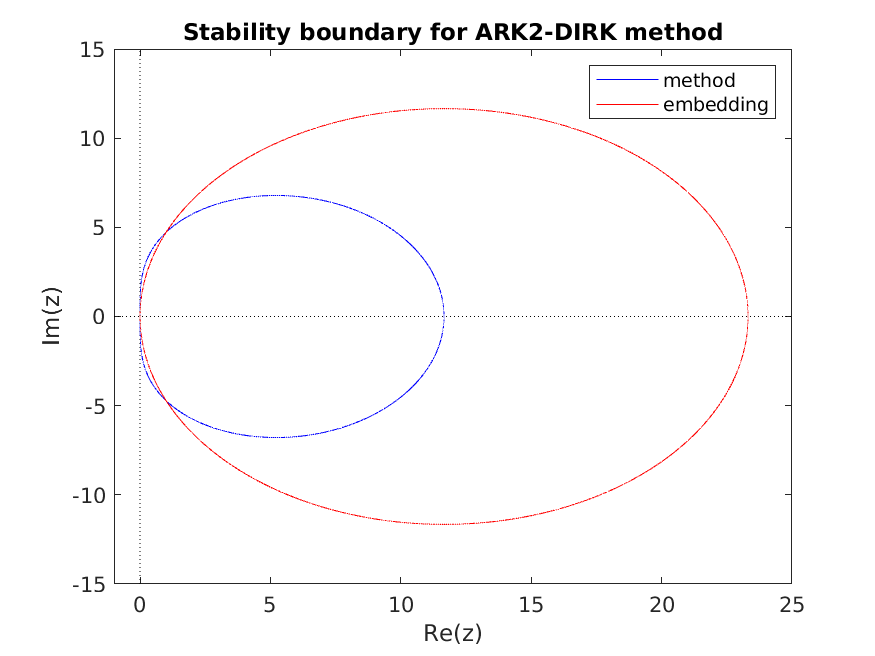
Fig. 2.36 Linear stability region for the ARK2-DIRK method. The method’s region is outlined in blue; the embedding’s region is in red.
-
enumerator ARKODE_SDIRK_2_1_2
Accessible via the constant ARKODE_SDIRK_2_1_2 to
ARKStepSetTableNum() or
ARKodeButcherTable_LoadDIRK().
Accessible via the string "ARKODE_SDIRK_2_1_2" to
ARKStepSetTableName() or
ARKodeButcherTable_LoadDIRKByName().
Both the method and embedding are A- and B-stable.
Changed in version 7.3.0 (ARKODE 6.3.0): Replaced by ARKODE_ARK2_DIRK_3_1_2 as the default 2nd order implicit method
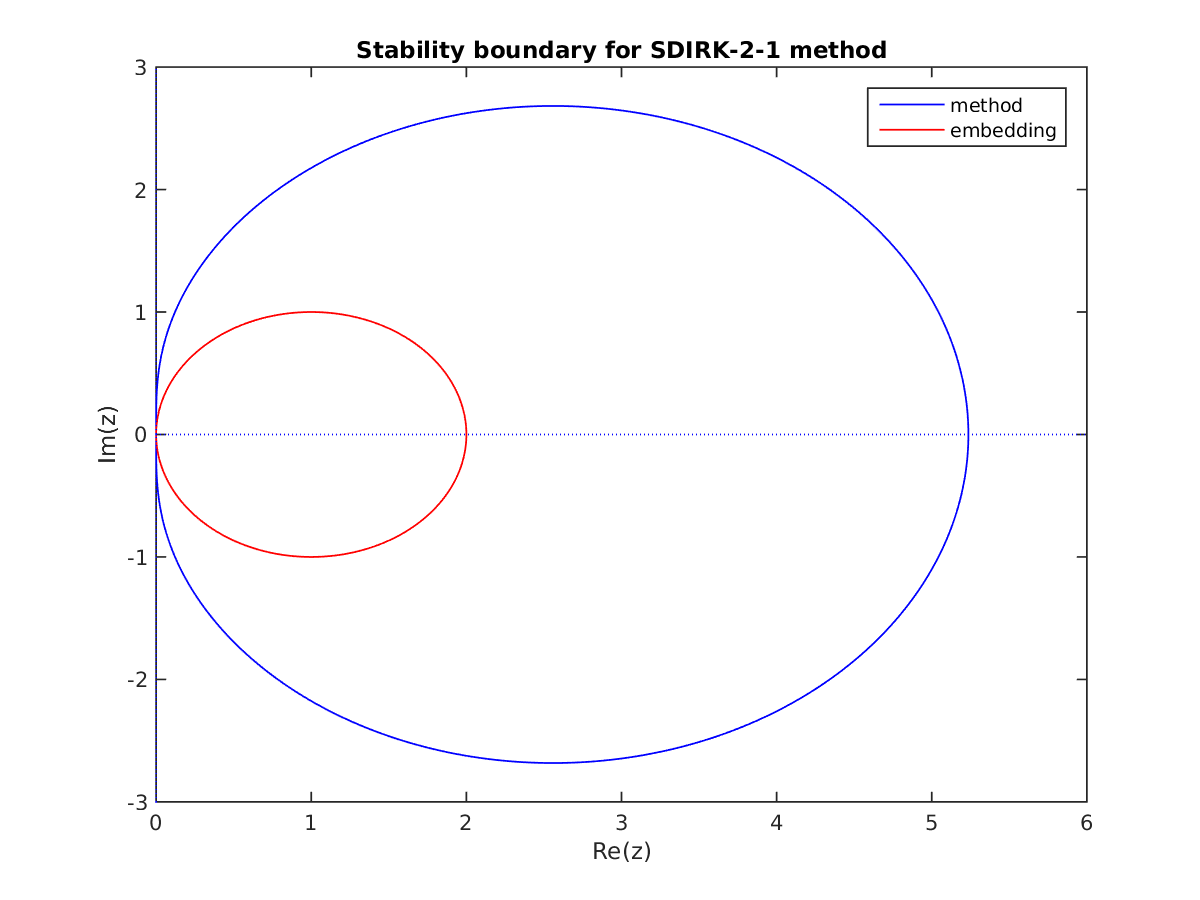
Fig. 2.37 Linear stability region for the SDIRK-2-1-2 method. The method’s region is outlined in blue; the embedding’s region is in red.
-
enumerator ARKODE_ASCHER_SDIRK_3_1_2
Accessible via the constant ARKODE_ASCHER_SDIRK_3_1_2 to
ARKStepSetTableNum(), or
ARKodeButcherTable_LoadDIRK().
Accessible via the string "ARKODE_ASCHER_SDIRK_3_1_2" to
ARKStepSetTableName(), or
ARKodeButcherTable_LoadDIRKByName().
The method is the implicit portion of the “(2,2,2)” additive Runge–Kutta
method from Section 2.6 of [15]; the embedding was invented
specifically for ARKODE. The method is both A- and L-stable, and the
embedding is A-stable.
Added in version 7.8.0 (6.8.0).
where \(\gamma = \frac{2-\sqrt{2}}{2}\).

Fig. 2.38 Linear stability region for the Ascher-SDIRK-3-1-2 method. The method’s region is outlined in red; the embedding’s region is in blue dashed.
-
enumerator ARKODE_SSP_DIRK_3_1_2
Accessible via the constant ARKODE_SSP_DIRK_3_1_2 to
ARKStepSetTableNum(), or
ARKodeButcherTable_LoadDIRK().
Accessible via the string "ARKODE_SSP_DIRK_3_1_2" to
ARKStepSetTableName(), or
ARKodeButcherTable_LoadDIRKByName().
The original method is the “IMEX-SSP2(3,3,2)” stiffly accurate method from
[116], with an embedding invented specifically for ARKODE. The method
is both A- and L-stable, while the embedding is A-stable. Both the method and
embedding have SSP coefficient equal to 2.4.
Added in version 7.8.0 (6.8.0).

Fig. 2.39 Linear stability region for the SSP-DIRK-3-1-2 method. The method’s region is outlined in red; the embedding’s region is in blue dashed.
-
enumerator ARKODE_SSP_LSPUM_SDIRK_3_1_2
Accessible via the constant ARKODE_SSP_LSPUM_SDIRK_3_1_2 to
ARKStepSetTableNum() or
ARKodeButcherTable_LoadDIRK().
Accessible via the string "ARKODE_SSP_LSPUM_SDIRK_3_1_2" to
ARKStepSetTableName() or
ARKodeButcherTable_LoadDIRKByName().
The method is the implicit portion of the “SSP2(3,3,2)-LSPUM” additive
Runge–Kutta method from [80]; the embedding was invented
specifically for ARKODE. The method is both A- and L-stable,
while the embedding is A-stable. Both the method and embedding have SSP
coefficient equal to 3.81.
Added in version 7.8.0 (6.8.0).

Fig. 2.40 Linear stability region for the SSP-LSPUM-SDIRK-3-1-2 method. The method’s region is outlined in red; the embedding’s region is in blue dashed.
-
enumerator ARKODE_IMPLICIT_MIDPOINT_1_2
Accessible via the constant ARKODE_IMPLICIT_MIDPOINT_1_2 to
ARKStepSetTableNum() or
ARKodeButcherTable_LoadDIRK().
Accessible via the string "ARKODE_IMPLICIT_MIDPOINT_1_2" to
ARKStepSetTableName() or
ARKodeButcherTable_LoadDIRKByName().
The method is A- and B-stable.
Warning
When using this non-embedded table, users must specify the
time step by calling ARKodeSetFixedStep().

Fig. 2.41 Linear stability region for the implicit midpoint method.
-
enumerator ARKODE_IMPLICIT_TRAPEZOIDAL_2_2
Accessible via the constant ARKODE_IMPLICIT_TRAPEZOIDAL_2_2 to
ARKStepSetTableNum() or
ARKodeButcherTable_LoadDIRK().
Accessible via the string "ARKODE_IMPLICIT_TRAPEZOIDAL_2_2" to
ARKStepSetTableName() or
ARKodeButcherTable_LoadDIRKByName().
The method is A-stable.
Warning
When using this non-embedded table, users must specify the
time step by calling ARKodeSetFixedStep().

Fig. 2.42 Linear stability region for the implicit trapezoidal method.
-
enumerator ARKODE_BILLINGTON_3_3_2
Accessible via the constant ARKODE_BILLINGTON_3_3_2 to
ARKStepSetTableNum() or
ARKodeButcherTable_LoadDIRK().
Accessible via the string "ARKODE_BILLINGTON_3_3_2" to
ARKStepSetTableName() or
ARKodeButcherTable_LoadDIRKByName().
Here, the higher-order embedding is less stable than the lower-order method
(from [19]).
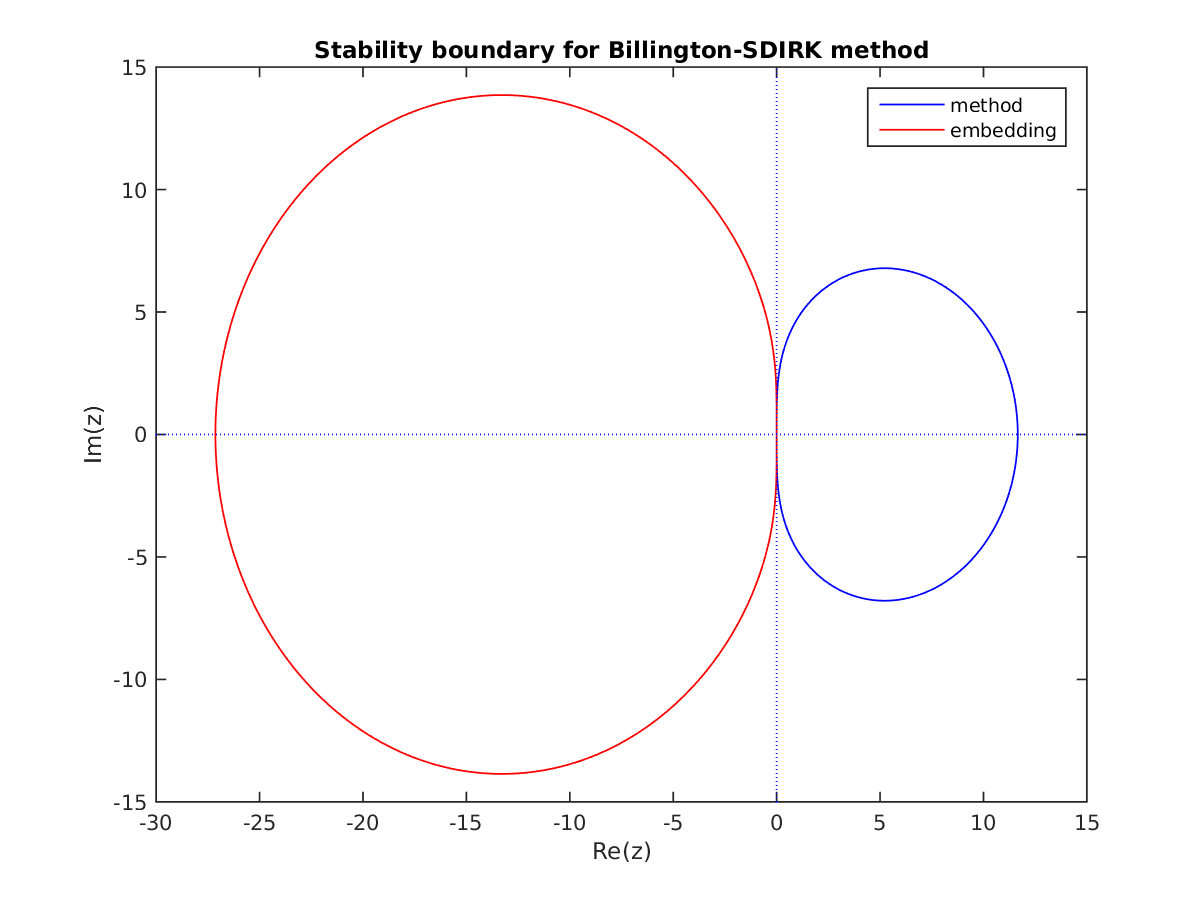
Fig. 2.43 Linear stability region for the Billington method. The method’s region is outlined in blue; the embedding’s region is in red.
-
enumerator ARKODE_TRBDF2_3_3_2
Accessible via the constant ARKODE_TRBDF2_3_3_2 to
ARKStepSetTableNum() or
ARKodeButcherTable_LoadDIRK().
Accessible via the string "ARKODE_TRBDF2_3_3_2" to
ARKStepSetTableName() or
ARKodeButcherTable_LoadDIRKByName().
As with Billington, here the higher-order embedding is less stable than the
lower-order method (from [18]).
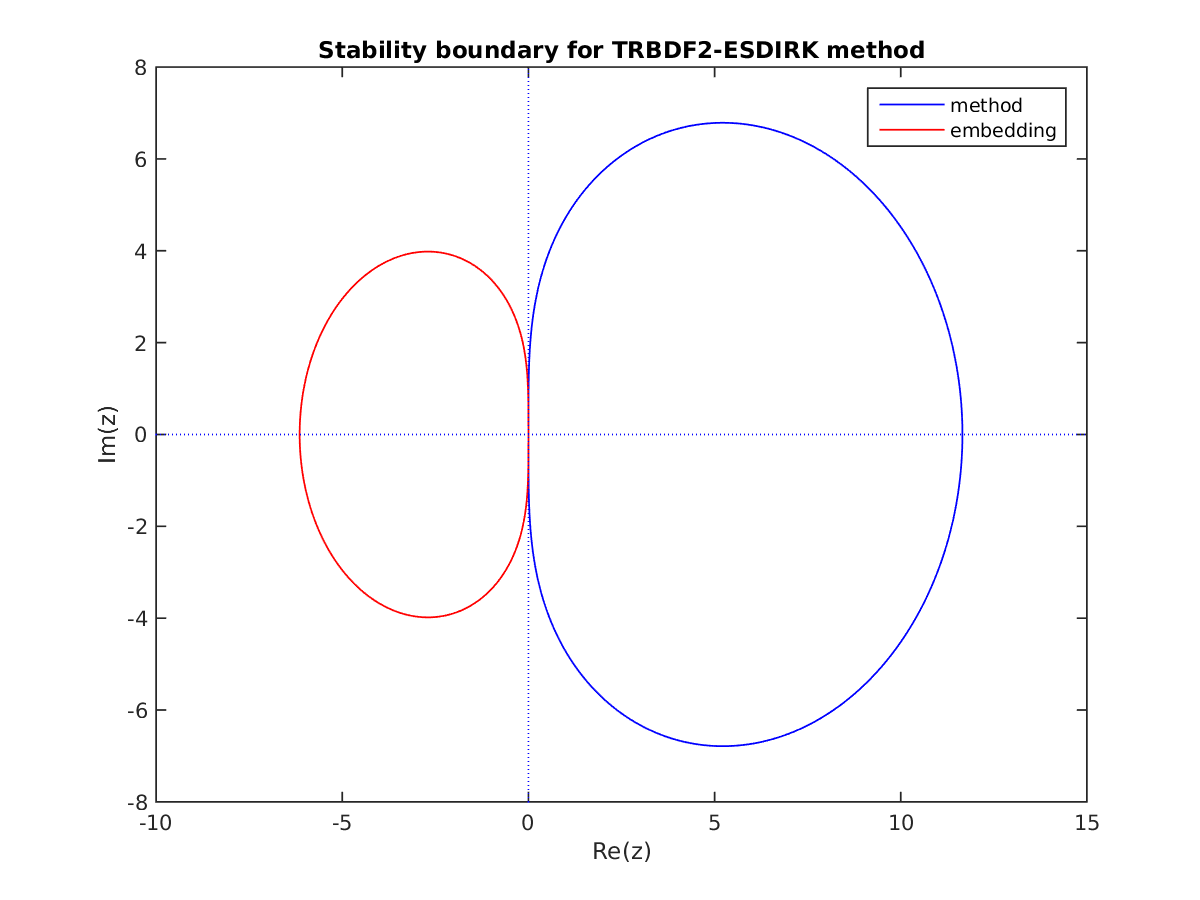
Fig. 2.44 Linear stability region for the TRBDF2 method. The method’s region is outlined in blue; the embedding’s region is in red.
-
enumerator ARKODE_ESDIRK325L2SA_5_2_3
Accessible via the constant ARKODE_ESDIRK325L2SA_5_2_3 to
ARKStepSetTableNum() or ARKodeButcherTable_LoadDIRK().
Accessible via the string "ARKODE_ESDIRK325L2SA_5_2_3" to
ARKStepSetTableName() or
ARKodeButcherTable_LoadDIRKByName().
This is the default 3rd order implicit method and the ESDIRK3(2)5L[2]SA method
from [97].
Both the method and embedding are A- and L-stable.
Changed in version 7.3.0 (ARKODE 6.3.0): Made the default 3rd order implicit method
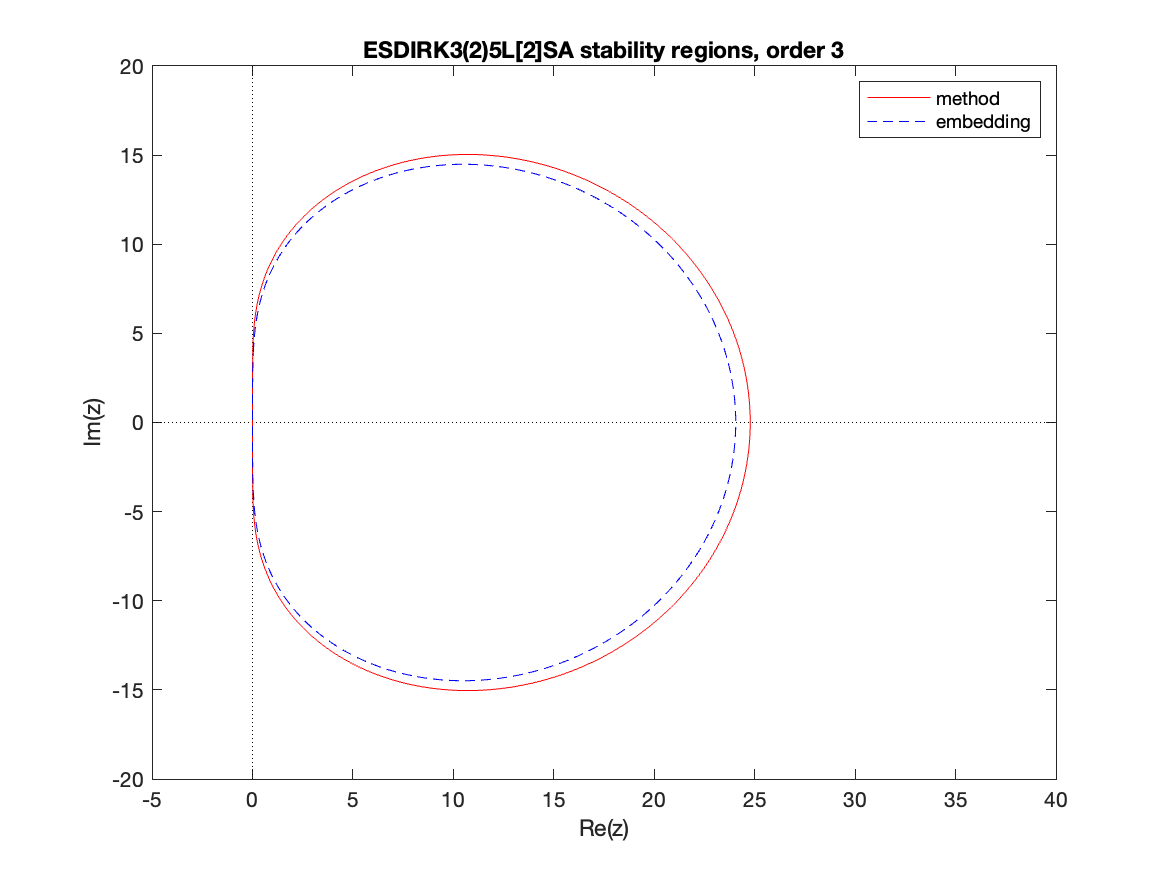
Fig. 2.45 Linear stability region for the ESDIRK325L2SA-5-2-3 method method. The method’s region is outlined in blue; the embedding’s region is in red.
-
enumerator ARKODE_ESDIRK_4_2_3
Accessible via the constant ARKODE_ESDIRK_4_2_3 to
ARKStepSetTableNum() or ARKodeButcherTable_LoadDIRK().
Accessible via the string "ARKODE_ESDIRK_4_2_3" to
ARKStepSetTableName() or
ARKodeButcherTable_LoadDIRKByName().
This method was invented specifically for ARKODE as an implicit method to
pair with ARKODE_SSP_ERK_4_2_3 for an embedded additive
Runge–Kutta method. The method is both A- and L-stable, and the
embedding is A-stable.
Added in version 7.8.0 (6.8.0).
where \(\gamma = 0.435866521508459\), \(\alpha = 0.1677218170940733\), \(\beta = 1.386012857827706\), and \(\eta = -0.8234932532713241\).

Fig. 2.46 Linear stability region for the SSP-ESDIRK-4-2-3 method. The method’s region is outlined in red; the embedding’s region is in blue dashed.
-
enumerator ARKODE_ESDIRK324L2SA_4_2_3
Accessible via the constant ARKODE_ESDIRK324L2SA_4_2_3 to
ARKStepSetTableNum() or ARKodeButcherTable_LoadDIRK().
Accessible via the string "ARKODE_ESDIRK324L2SA_4_2_3" to
ARKStepSetTableName() or
ARKodeButcherTable_LoadDIRKByName().
This is the ESDIRK3(2)4L[2]SA method from [98].
Both the method and embedding are A- and L-stable.
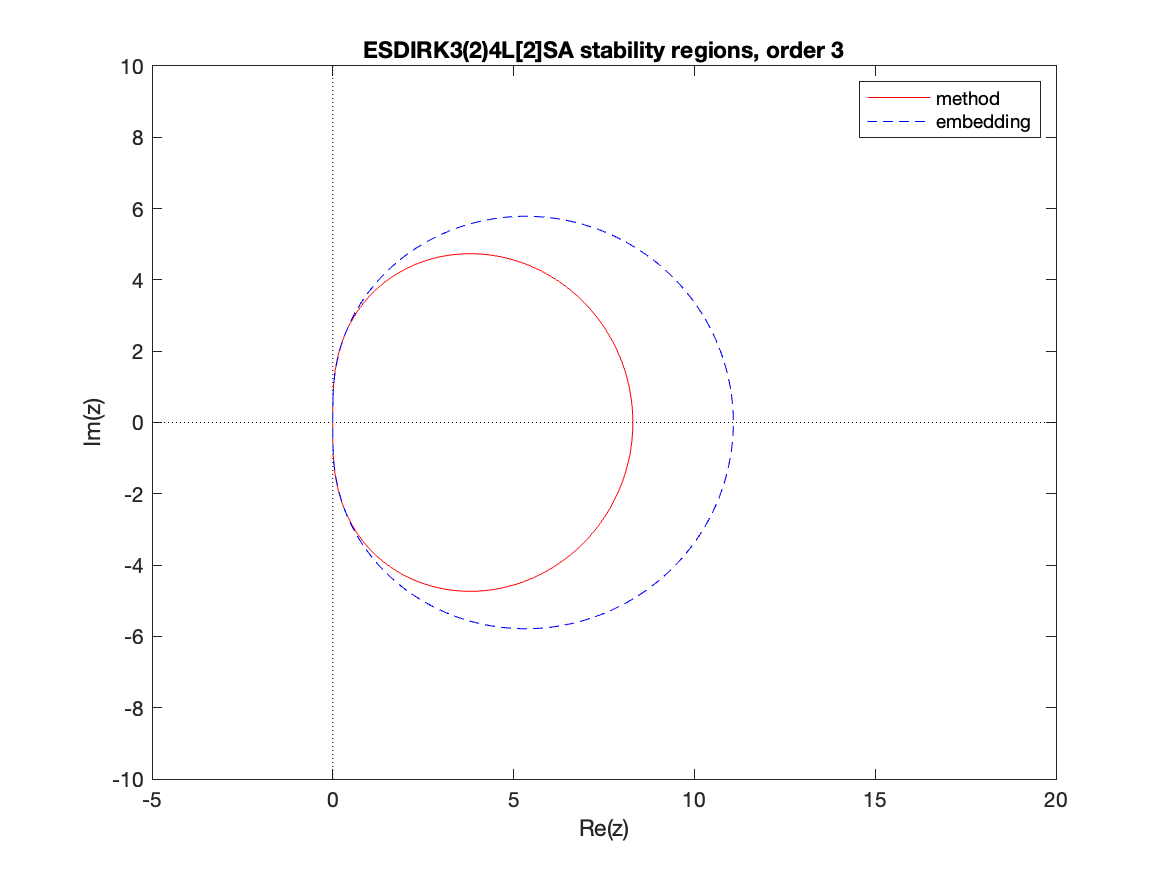
Fig. 2.47 Linear stability region for the ESDIRK324L2SA-4-2-3 method method. The method’s region is outlined in blue; the embedding’s region is in red.
-
enumerator ARKODE_ESDIRK32I5L2SA_5_2_3
Accessible via the constant ARKODE_ESDIRK32I5L2SA_5_2_3 to
ARKStepSetTableNum() or ARKodeButcherTable_LoadDIRK().
Accessible via the string "ARKODE_ESDIRK32I5L2SA_5_2_3" to
ARKStepSetTableName() or
ARKodeButcherTable_LoadDIRKByName().
This is the ESDIRK3(2I)5L[2]SA method from [97].
Both the method and embedding are A- and L-stable.
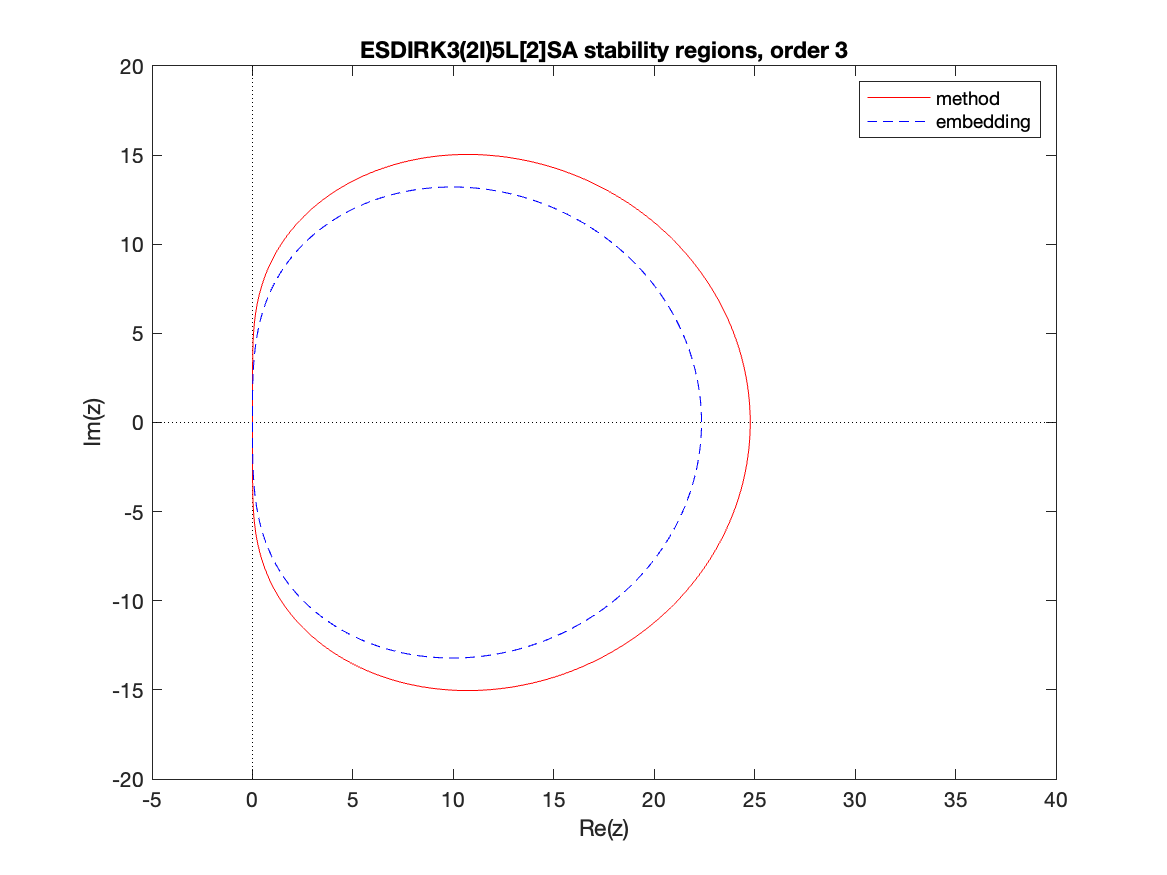
Fig. 2.48 Linear stability region for the ESDIRK32I5L2SA-5-2-3 method method. The method’s region is outlined in blue; the embedding’s region is in red.
-
enumerator ARKODE_KVAERNO_4_2_3
Accessible via the constant ARKODE_KVAERNO_4_2_3 to
ARKStepSetTableNum() or
ARKodeButcherTable_LoadDIRK().
Accessible via the string "ARKODE_KVAERNO_4_2_3" to
ARKStepSetTableName() or
ARKodeButcherTable_LoadDIRKByName().
Both the method and embedding are A-stable; additionally the method is L-stable
(from [103]).
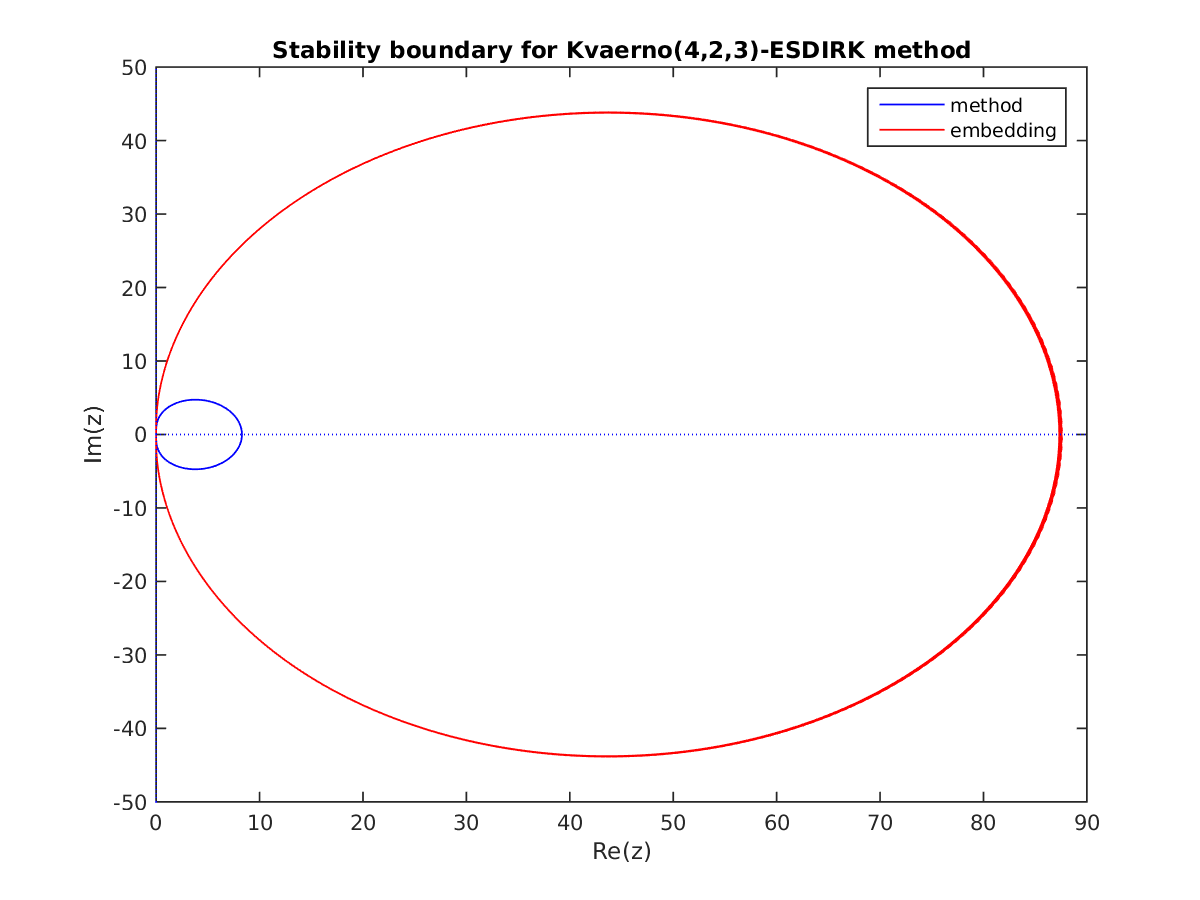
Fig. 2.49 Linear stability region for the Kvaerno-4-2-3 method. The method’s region is outlined in blue; the embedding’s region is in red.
-
enumerator ARKODE_ARK324L2SA_DIRK_4_2_3
Accessible via the constant ARKODE_ARK324L2SA_DIRK_4_2_3 to
ARKStepSetTableNum() or
ARKodeButcherTable_LoadDIRK().
Accessible via the string "ARKODE_ARK324L2SA_DIRK_4_2_3" to
ARKStepSetTableName() or
ARKodeButcherTable_LoadDIRKByName().
This is the implicit portion of the default 3rd order additive method. Both the
method and embedding are A-stable; additionally the method is L-stable
(this is the implicit portion of the ARK3(2)4L[2]SA method from
[96]).
Changed in version 7.3.0 (ARKODE 6.3.0): Replaced by ARKODE_ESDIRK325L2SA_5_2_3 as the default 3rd order implicit method
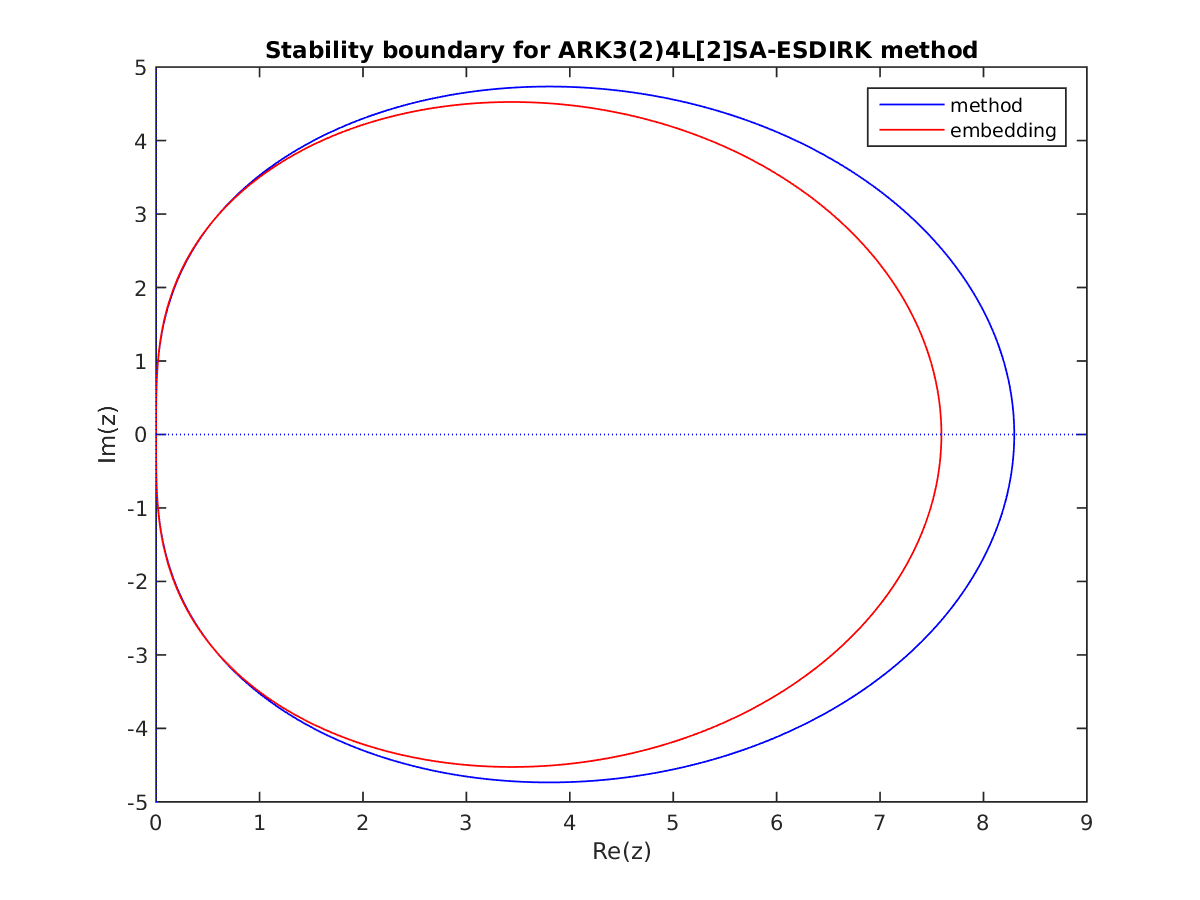
Fig. 2.50 Linear stability region for the implicit ARK324L2SA-DIRK-4-2-3 method. The method’s region is outlined in blue; the embedding’s region is in red.
-
enumerator ARKODE_ESDIRK436L2SA_6_3_4
Accessible via the constant ARKODE_ESDIRK436L2SA_6_3_4 to
ARKStepSetTableNum() or ARKodeButcherTable_LoadDIRK().
Accessible via the string "ARKODE_ESDIRK436L2SA_6_3_4" to
ARKStepSetTableName() or
ARKodeButcherTable_LoadDIRKByName().
This is the default 4th order implicit method and the ESDIRK4(3)6L[2]SA method
from [97]. Both the method and embedding are A- and L-stable.
Changed in version 7.3.0 (ARKODE 6.3.0): Made the default 4th order implicit method
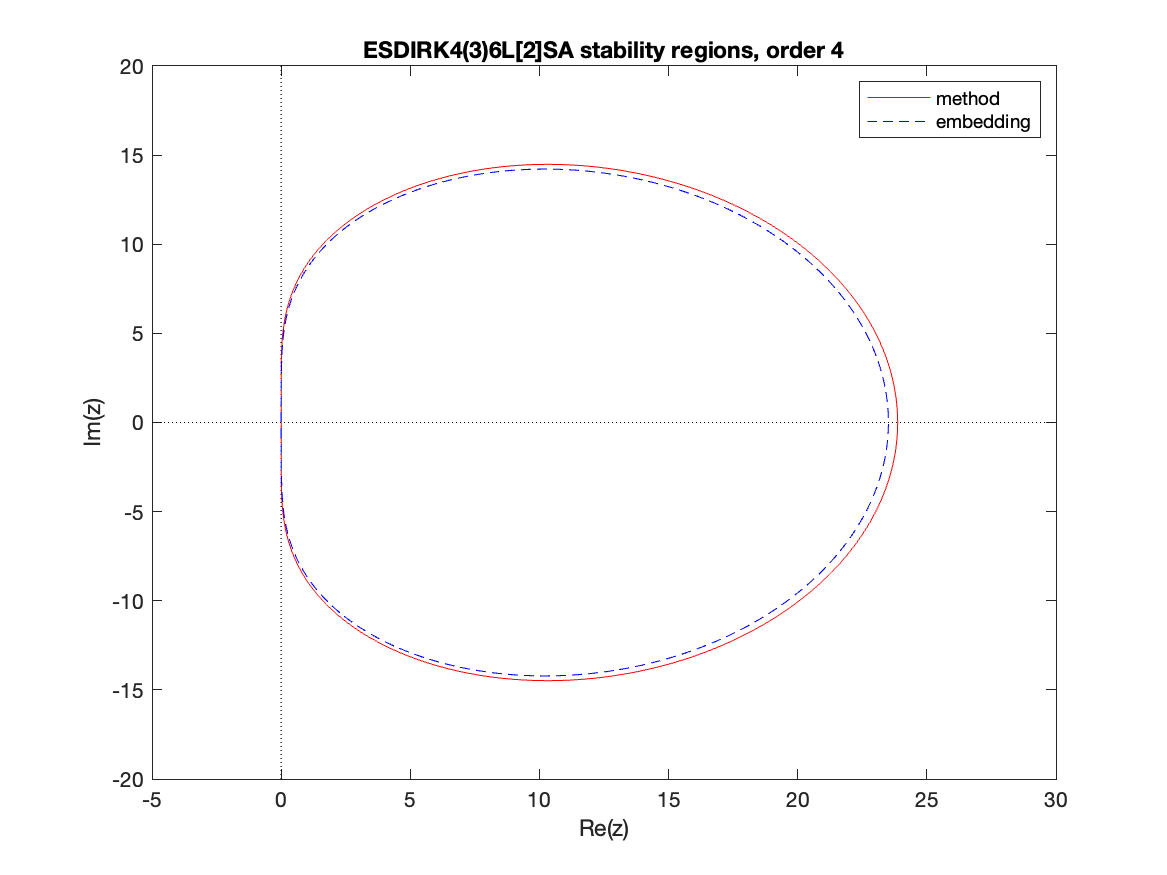
Fig. 2.51 Linear stability region for the ESDIRK436L2SA-6-3-4 method method. The method’s region is outlined in blue; the embedding’s region is in red.
-
enumerator ARKODE_CASH_5_2_4
Accessible via the constant ARKODE_CASH_5_2_4 to
ARKStepSetTableNum() or
ARKodeButcherTable_LoadDIRK().
Accessible via the string "ARKODE_CASH_5_2_4" to
ARKStepSetTableName() or
ARKodeButcherTable_LoadDIRKByName().
Both the method and embedding are A-stable; additionally the method is L-stable
(from [38]).
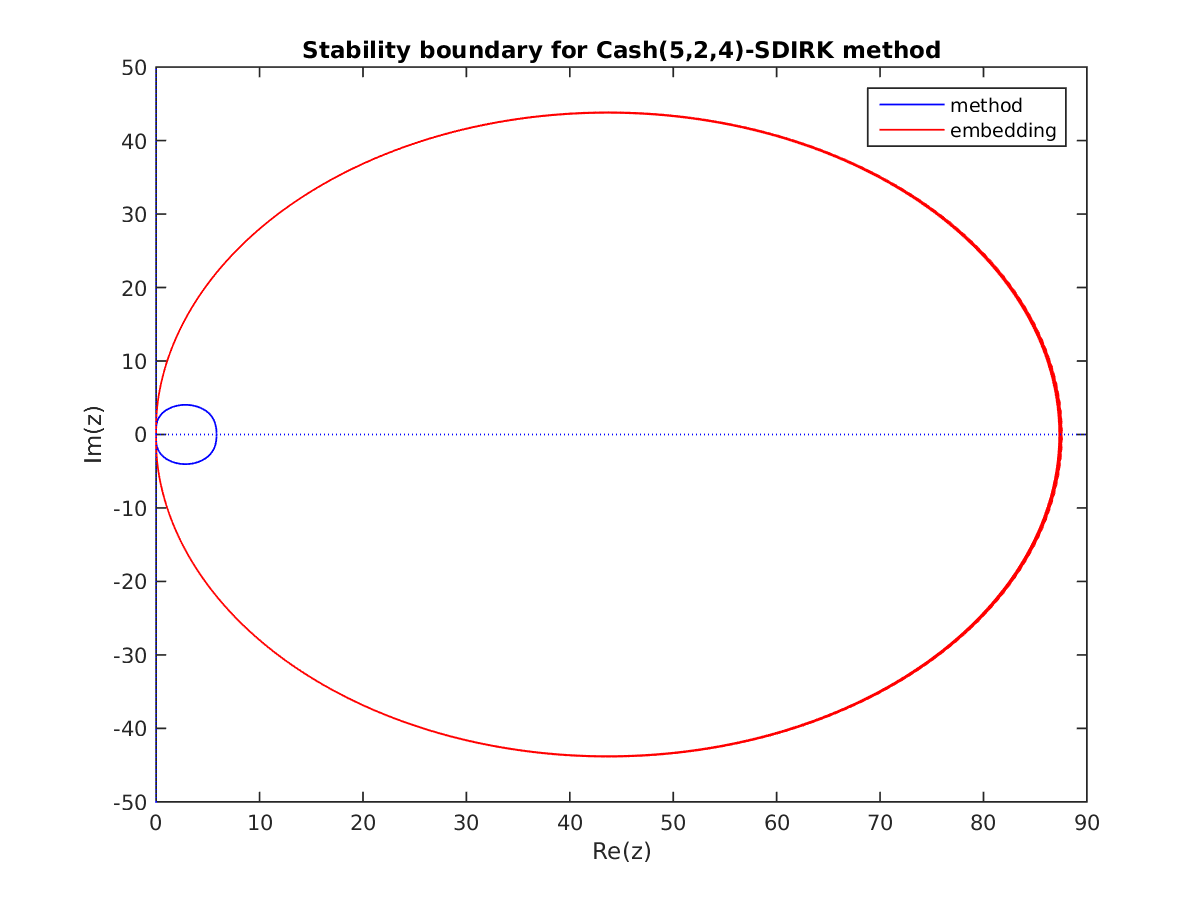
Fig. 2.52 Linear stability region for the Cash-5-2-4 method. The method’s region is outlined in blue; the embedding’s region is in red.
-
enumerator ARKODE_CASH_5_3_4
Accessible via the constant ARKODE_CASH_5_3_4 to
ARKStepSetTableNum() or
ARKodeButcherTable_LoadDIRK().
Accessible via the string "ARKODE_CASH_5_3_4" to
ARKStepSetTableName() or
ARKodeButcherTable_LoadDIRKByName().
Both the method and embedding are A-stable; additionally the method is L-stable
(from [38]).
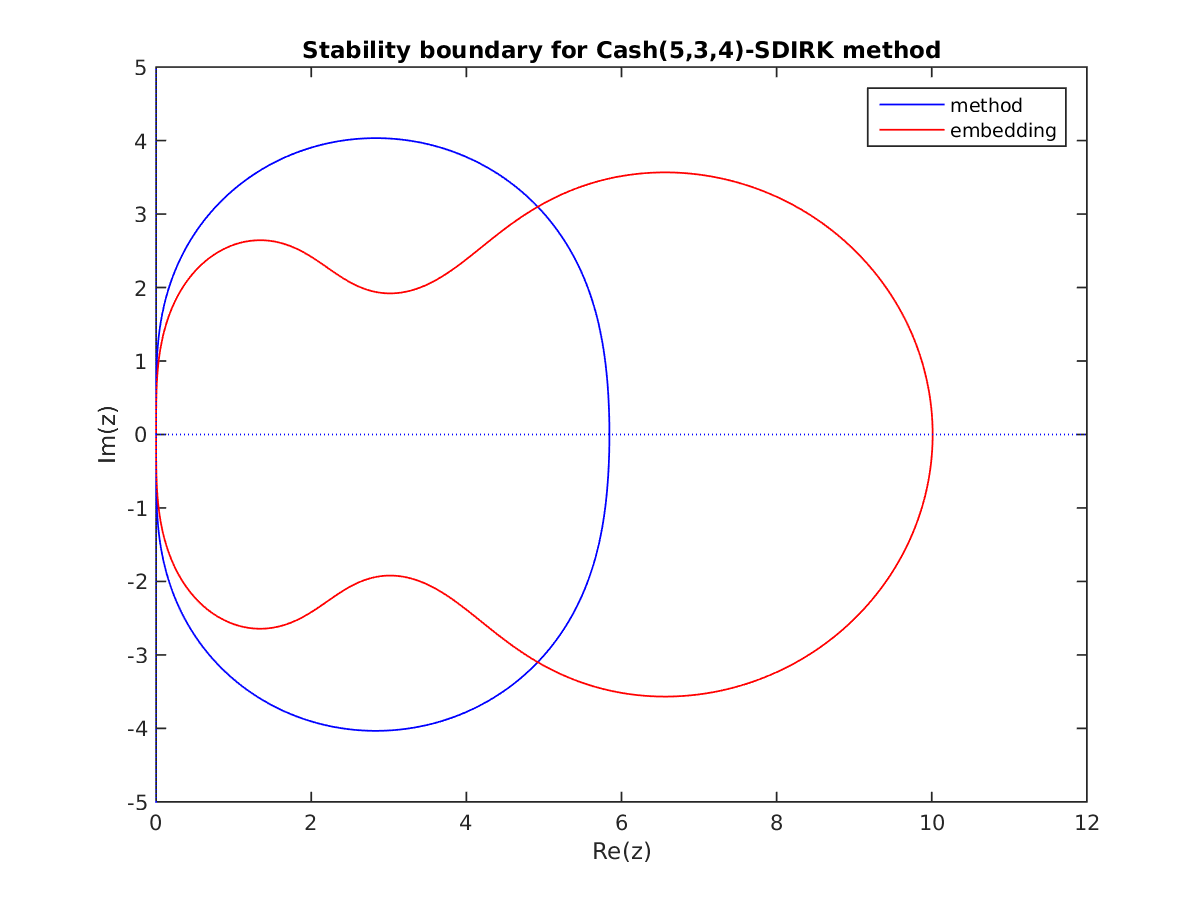
Fig. 2.53 Linear stability region for the Cash-5-3-4 method. The method’s region is outlined in blue; the embedding’s region is in red.
-
enumerator ARKODE_SDIRK_5_3_4
Accessible via the constant ARKODE_SDIRK_5_3_4 to
ARKStepSetTableNum() or
ARKodeButcherTable_LoadDIRK().
Accessible via the string "ARKODE_SDIRK_5_3_4" to
ARKStepSetTableName() or
ARKodeButcherTable_LoadDIRKByName().
Here, the method is both A- and L-stable, although the embedding has reduced
stability (from [75]).
Changed in version 7.3.0 (ARKODE 6.3.0): Replaced by ARKODE_ESDIRK436L2SA_6_3_4 as the default 4th order implicit method
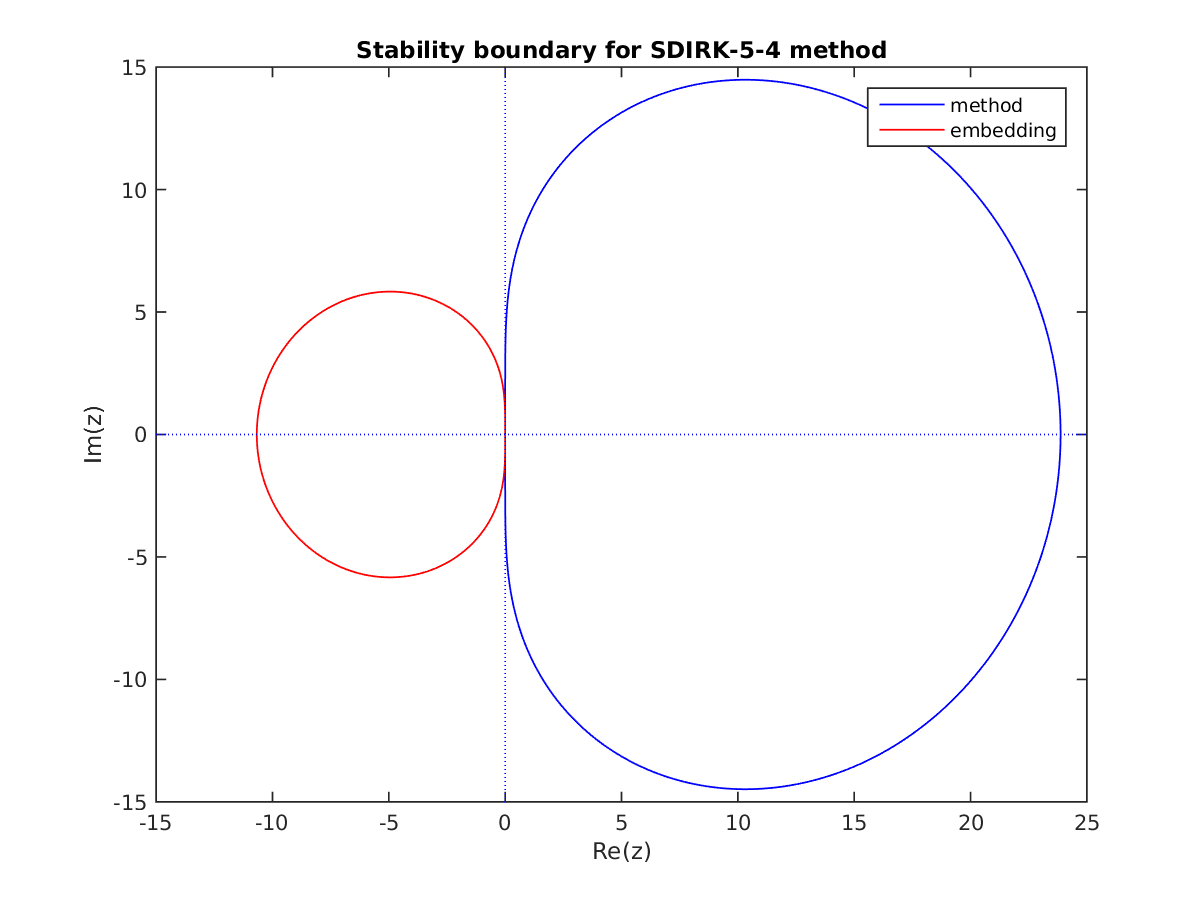
Fig. 2.54 Linear stability region for the SDIRK-5-3-4 method. The method’s region is outlined in blue; the embedding’s region is in red.
-
enumerator ARKODE_KVAERNO_5_3_4
Accessible via the constant ARKODE_KVAERNO_5_3_4 to
ARKStepSetTableNum() or
ARKodeButcherTable_LoadDIRK().
Accessible via the string "ARKODE_KVAERNO_5_3_4" to
ARKStepSetTableName() or
ARKodeButcherTable_LoadDIRKByName().
Both the method and embedding are A-stable (from [103]).
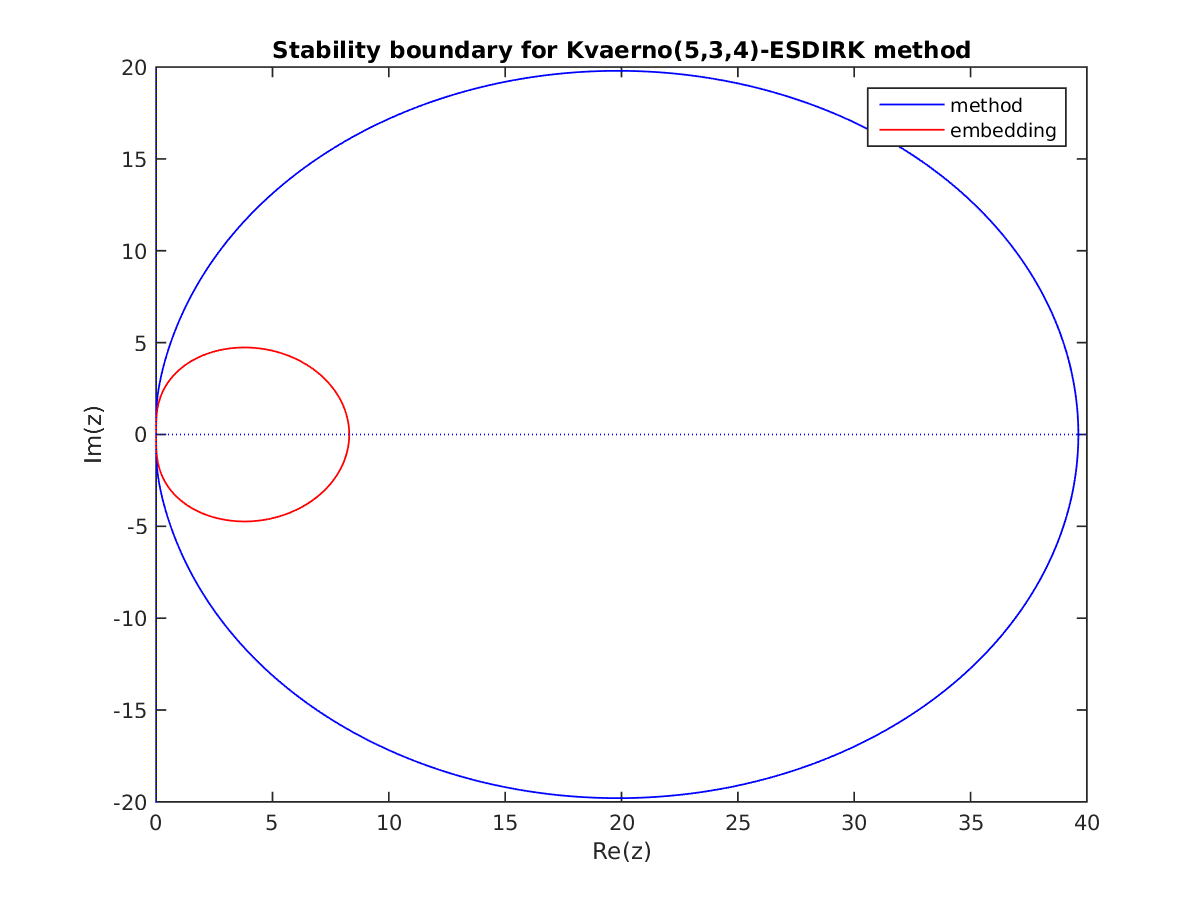
Fig. 2.55 Linear stability region for the Kvaerno-5-3-4 method. The method’s region is outlined in blue; the embedding’s region is in red.
-
enumerator ARKODE_ARK436L2SA_DIRK_6_3_4
Accessible via the constant ARKODE_ARK436L2SA_DIRK_6_3_4 to
ARKStepSetTableNum() or
ARKodeButcherTable_LoadDIRK().
Accessible via the string "ARKODE_ARK436L2SA_DIRK_6_3_4" to
ARKStepSetTableName() or
ARKodeButcherTable_LoadDIRKByName().
Both the method and embedding are A-stable; additionally the method is L-stable
(this is the implicit portion of the ARK4(3)6L[2]SA method from
[96]).
Changed in version 7.3.0 (ARKODE 6.3.0): Replaced by ARKODE_ARK437L2SA_DIRK_7_3_4 as the implicit portion of the default 4th order additive method
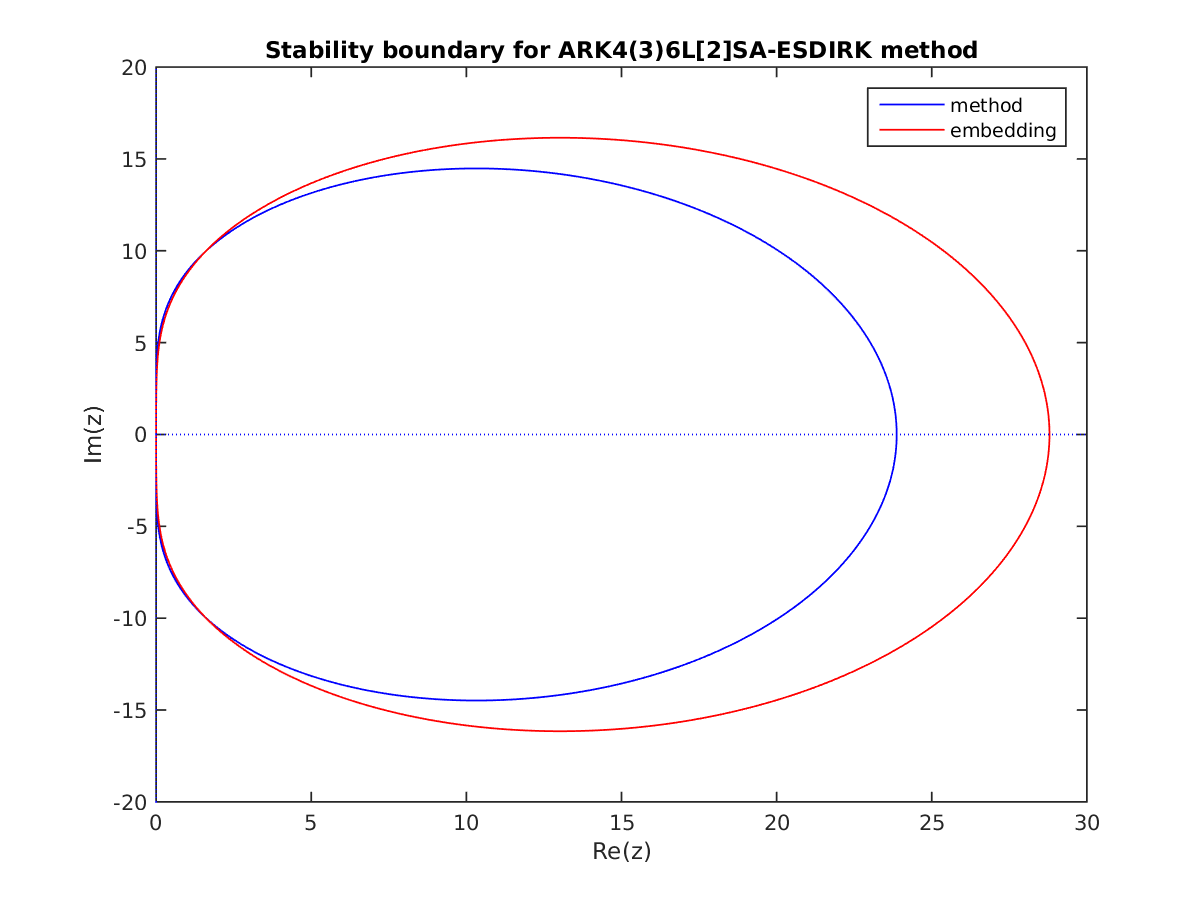
Fig. 2.56 Linear stability region for the ARK436L2SA-DIRK-6-3-4 method. The method’s region is outlined in blue; the embedding’s region is in red.
-
enumerator ARKODE_ARK437L2SA_DIRK_7_3_4
Accessible via the constant ARKODE_ARK437L2SA_DIRK_7_3_4 to
ARKStepSetTableNum() or
ARKodeButcherTable_LoadDIRK().
Accessible via the string "ARKODE_ARK437L2SA_DIRK_7_3_4" to
ARKStepSetTableName() or
ARKodeButcherTable_LoadDIRKByName().
This is the implicit portion of the default 4th order additive method and the
implicit portion of the 4th order ARK4(3)7L[2]SA method from
[99]. Both the method and embedding are A- and L-stable.
Changed in version 7.3.0 (ARKODE 6.3.0): Made the implicit portion of the default 4th order additive method
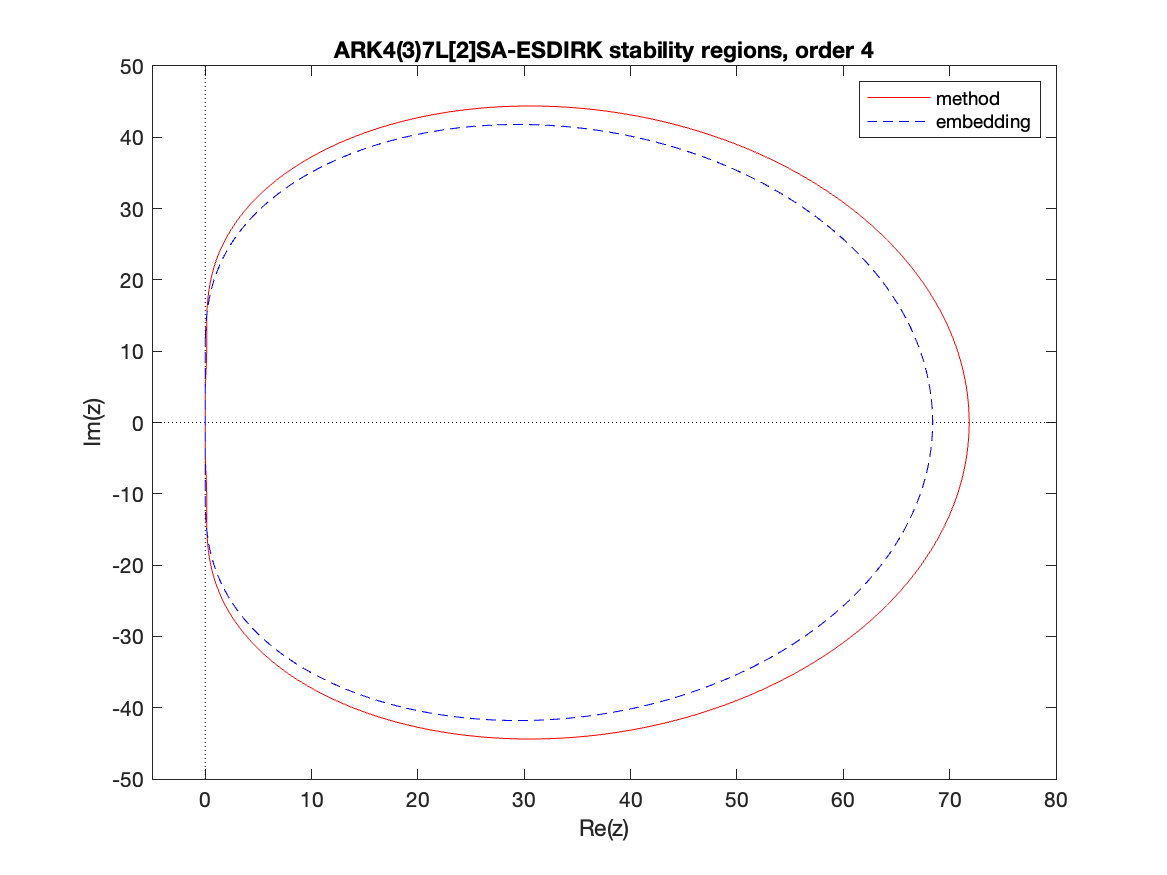
Fig. 2.57 Linear stability region for the ARK437L2SA-DIRK-7-3-4 method. The method’s region is outlined in blue; the embedding’s region is in red.
-
enumerator ARKODE_ESDIRK43I6L2SA_6_3_4
Accessible via the constant ARKODE_ESDIRK43I6L2SA_6_3_4 to
ARKStepSetTableNum() or ARKodeButcherTable_LoadDIRK().
Accessible via the string "ARKODE_ESDIRK43I6L2SA_6_3_4" to
ARKStepSetTableName() or
ARKodeButcherTable_LoadDIRKByName().
This is the ESDIRK4(3I)6L[2]SA method from [97].
Both the method and embedding are A- and L-stable.
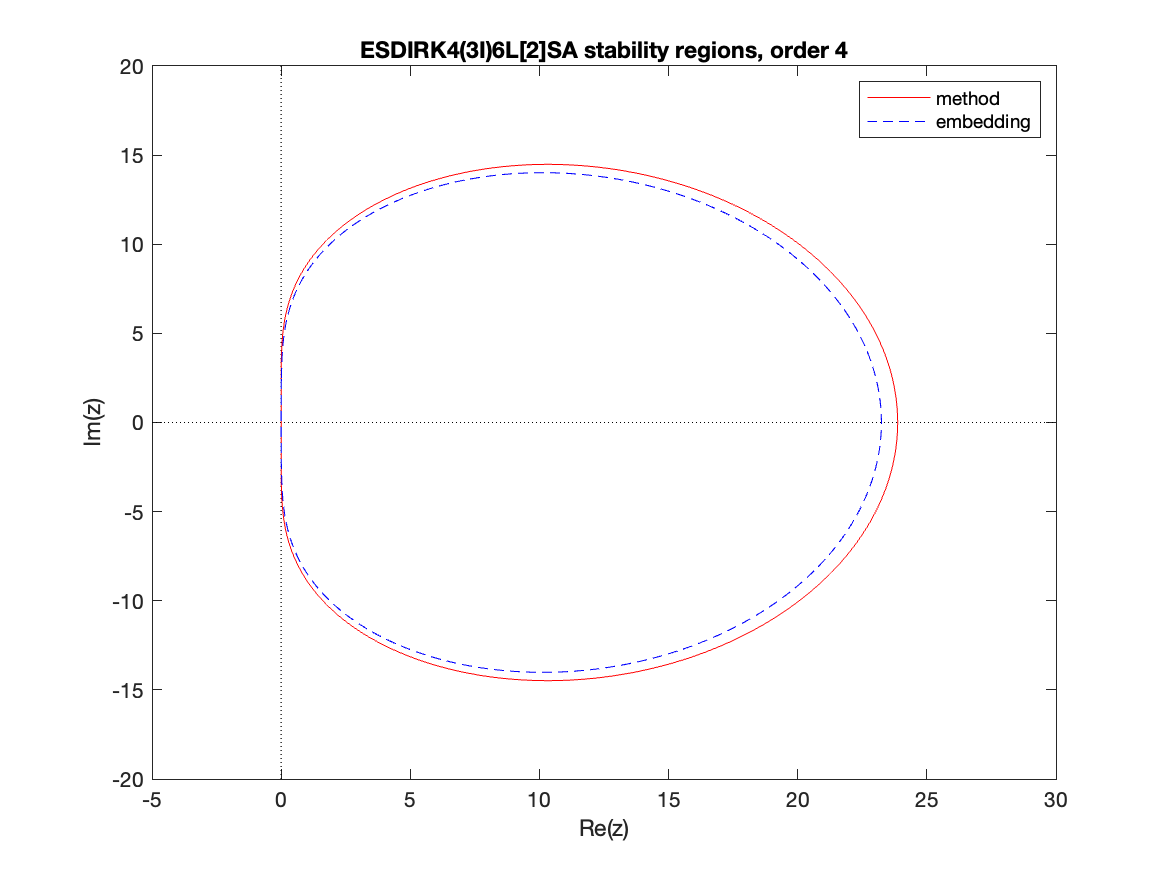
Fig. 2.58 Linear stability region for the ESDIRK43I6L2SA-6-3-4 method method. The method’s region is outlined in blue; the embedding’s region is in red.
-
enumerator ARKODE_QESDIRK436L2SA_6_3_4
Accessible via the constant ARKODE_QESDIRK436L2SA_6_3_4 to
ARKStepSetTableNum() or ARKodeButcherTable_LoadDIRK().
Accessible via the string "ARKODE_QESDIRK436L2SA_6_3_4" to
ARKStepSetTableName() or
ARKodeButcherTable_LoadDIRKByName().
This is the QESDIRK4(3)6L[2]SA method from [97].
Both the method and embedding are A- and L-stable.
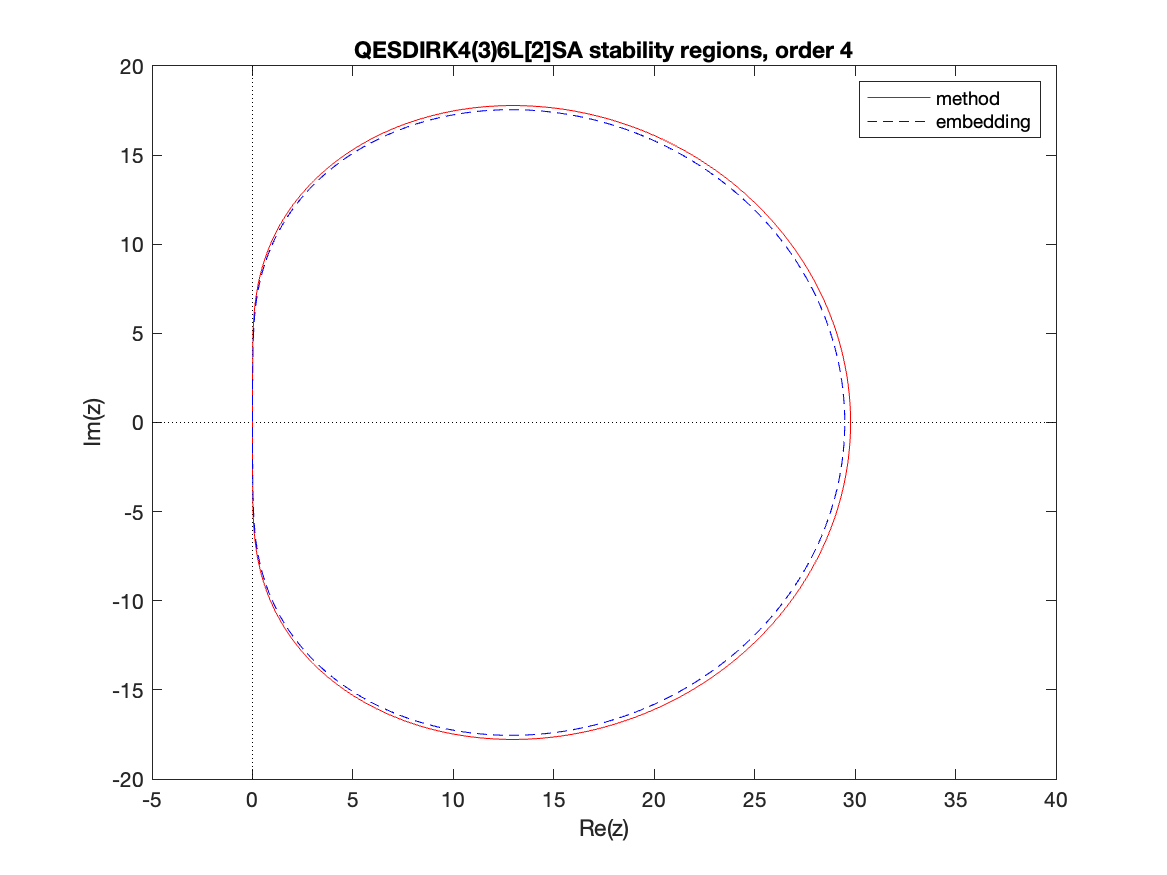
Fig. 2.59 Linear stability region for the QESDIRK436L2SA-6-3-4 method method. The method’s region is outlined in blue; the embedding’s region is in red.
-
enumerator ARKODE_ESDIRK437L2SA_7_3_4
Accessible via the constant ARKODE_ESDIRK437L2SA_7_3_4 to
ARKStepSetTableNum() or ARKodeButcherTable_LoadDIRK().
Accessible via the string "ARKODE_ESDIRK437L2SA_7_3_4" to
ARKStepSetTableName() or
ARKodeButcherTable_LoadDIRKByName().
This is the ESDIRK4(3)7L[2]SA method from [98].
Both the method and embedding are A- and L-stable.
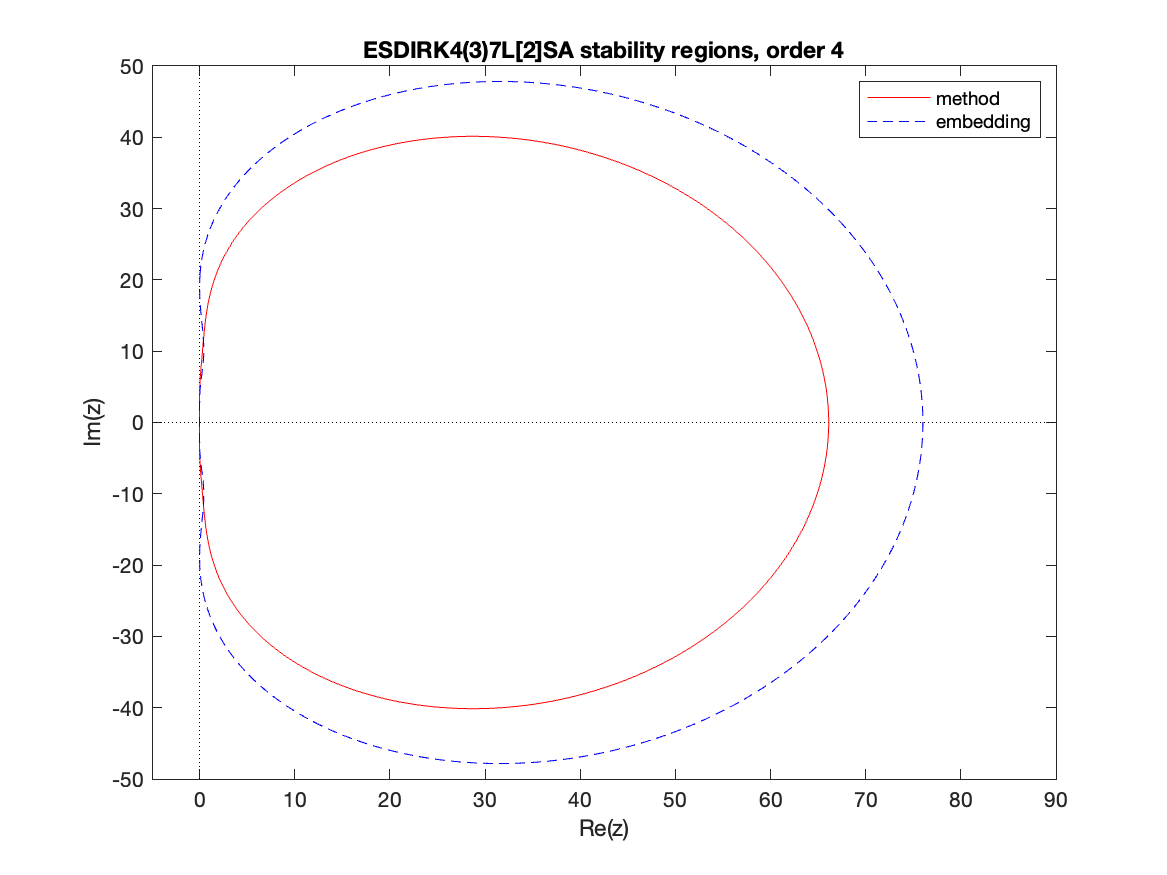
Fig. 2.60 Linear stability region for the ESDIRK437L2SA-7-3-4 method method. The method’s region is outlined in blue; the embedding’s region is in red.
-
enumerator ARKODE_ESDIRK547L2SA2_7_4_5
Accessible via the constant ARKODE_ESDIRK547L2SA2_7_4_5 to
ARKStepSetTableNum() or ARKodeButcherTable_LoadDIRK().
Accessible via the string "ARKODE_ESDIRK547L2SA2_7_4_5" to
ARKStepSetTableName() or
ARKodeButcherTable_LoadDIRKByName().
This is the default 5th order implicit method and the ESDIRK5(4)7L[2]SA2 method
from [98]. Both the method and embedding are A- and L-stable.
Changed in version 7.3.0 (ARKODE 6.3.0): Made the default 5th order implicit method
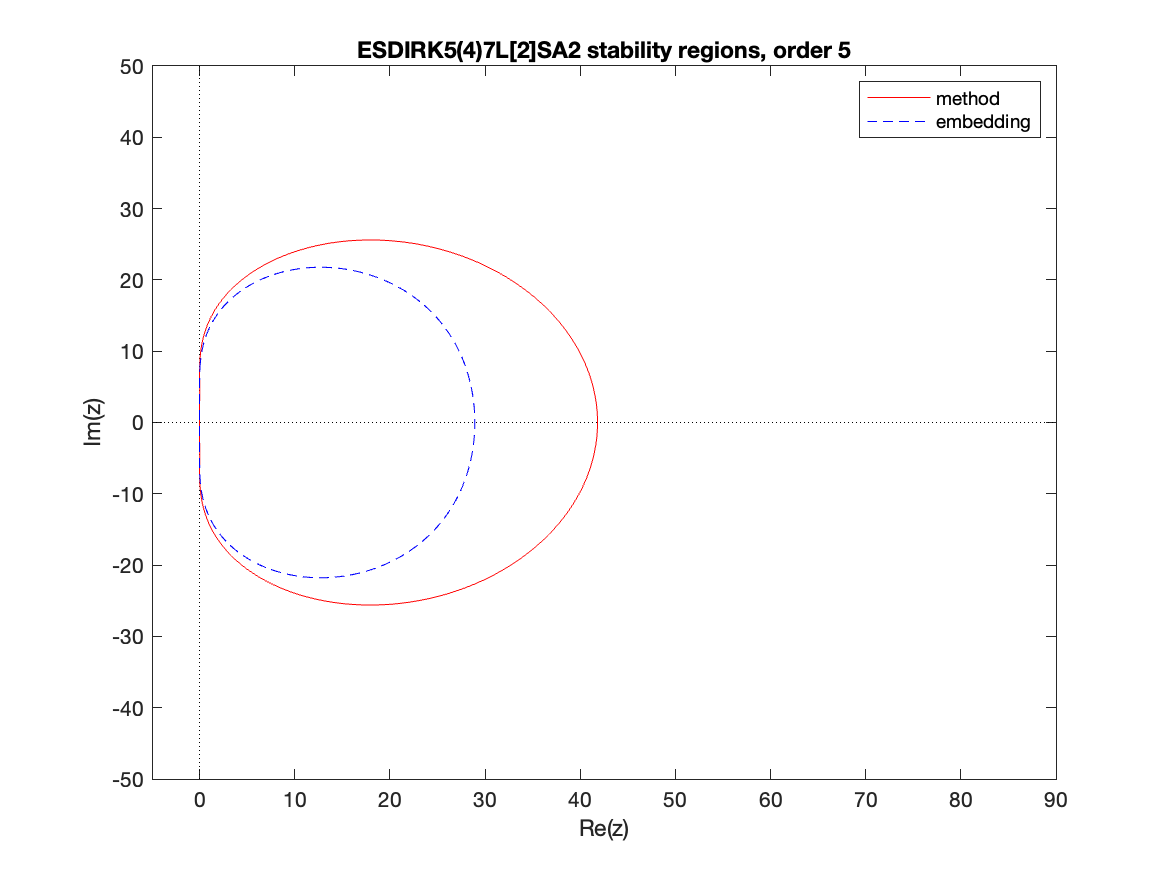
Fig. 2.61 Linear stability region for the ESDIRK547L2SA2-7-4-5 method method. The method’s region is outlined in blue; the embedding’s region is in red.
-
enumerator ARKODE_KVAERNO_7_4_5
Accessible via the constant ARKODE_KVAERNO_7_4_5 to
ARKStepSetTableNum() or
ARKodeButcherTable_LoadDIRK().
Accessible via the string "ARKODE_KVAERNO_7_4_5" to
ARKStepSetTableName() or
ARKodeButcherTable_LoadDIRKByName().
Both the method and embedding are A-stable; additionally the method is
L-stable (from [103]).
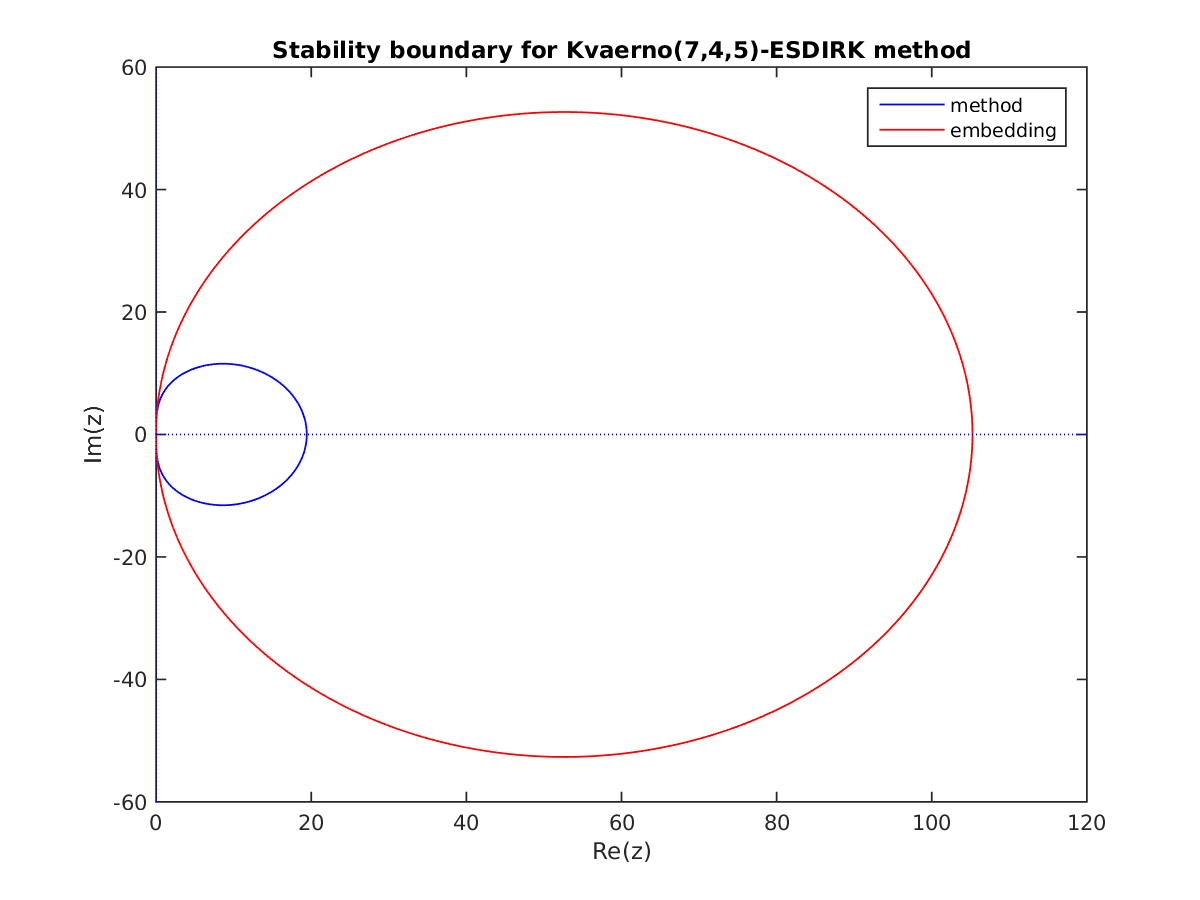
Fig. 2.62 Linear stability region for the Kvaerno-7-4-5 method. The method’s region is outlined in blue; the embedding’s region is in red.
-
enumerator ARKODE_ARK548L2SA_DIRK_8_4_5
Accessible via the constant ARKODE_ARK548L2SA_DIRK_8_4_5 for
ARKStepSetTableNum() or
ARKodeButcherTable_LoadDIRK().
Accessible via the string "ARKODE_ARK548L2SA_DIRK_8_4_5" to
ARKStepSetTableName() or
ARKodeButcherTable_LoadDIRKByName().
Both the method and embedding are A-stable; additionally the method is L-stable
(the implicit portion of the ARK5(4)8L[2]SA method from [96]).
Changed in version 7.3.0 (ARKODE 6.3.0): Replaced by ARKODE_ESDIRK547L2SA2_7_4_5 as the default 5th order implicit method and replaced by ARKODE_ARK548L2SAb_DIRK_8_4_5 as the implicit portion of the default 5th order additive method
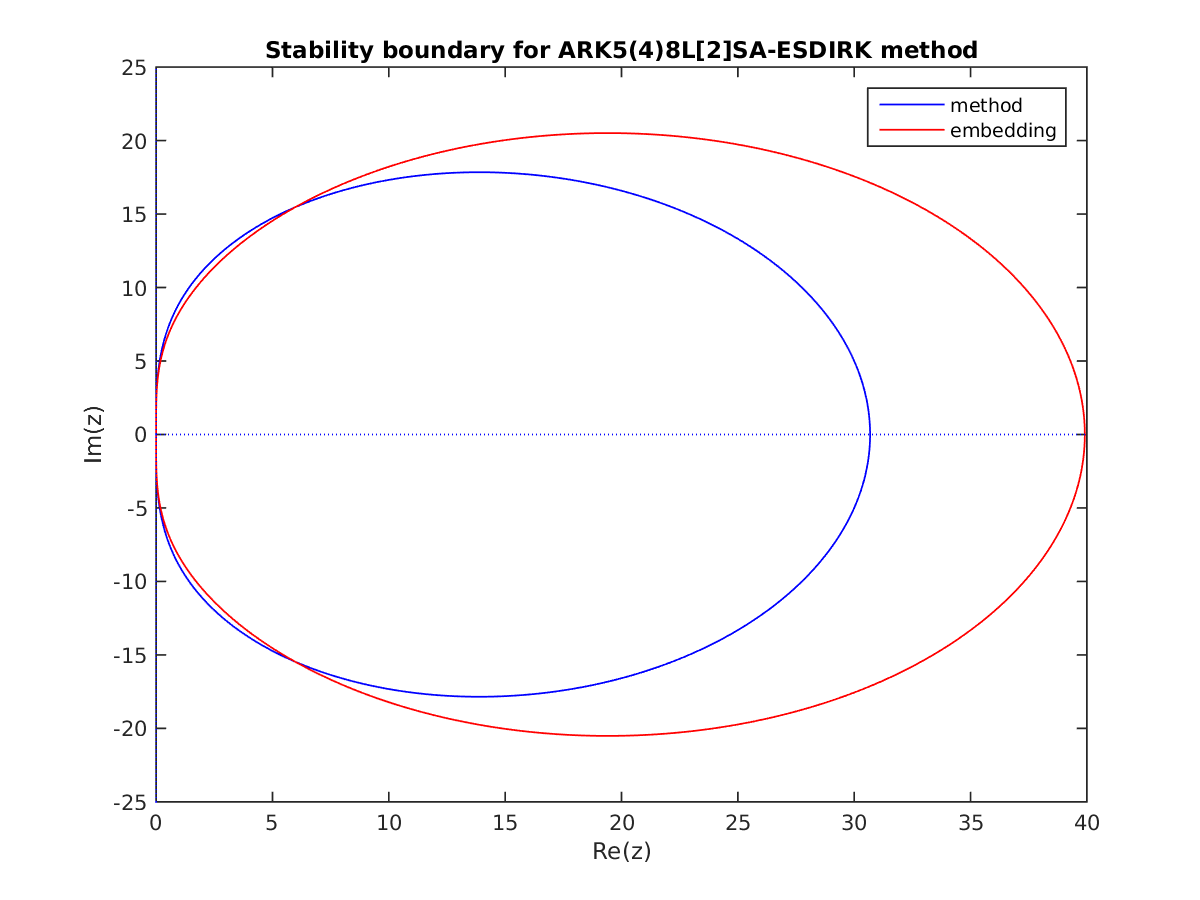
Fig. 2.63 Linear stability region for the implicit ARK548L2SA-ESDIRK-8-4-5 method. The method’s region is outlined in blue; the embedding’s region is in red.
-
enumerator ARKODE_ARK548L2SAb_DIRK_8_4_5
Accessible via the constant ARKODE_ARK548L2SAb_DIRK_8_4_5 for
ARKStepSetTableNum() or
ARKodeButcherTable_LoadDIRK().
Accessible via the string "ARKODE_ARK548L2SAb_DIRK_8_4_5" to
ARKStepSetTableName() or
ARKodeButcherTable_LoadDIRKByName().
This is the implicit portion of the default 5th order additive method.
Both the method and embedding are A-stable; additionally the method is L-stable
(this is the implicit portion of the 5th order ARK5(4)8L[2]SA method from
[99]).
Changed in version 7.3.0 (ARKODE 6.3.0): Made the implicit portion of the default 5th order additive method
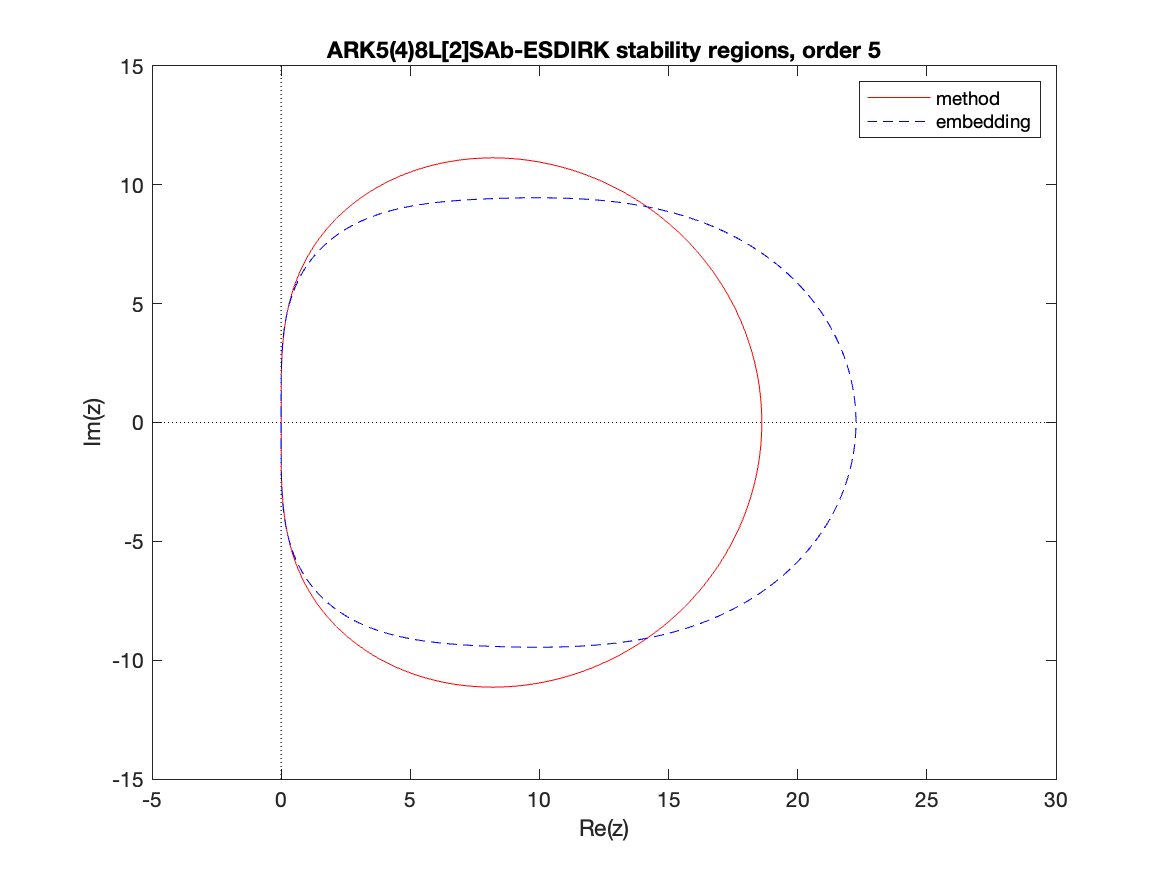
Fig. 2.64 Linear stability region for the ARK548L2SAb-DIRK-8-4-5 method. The method’s region is outlined in blue; the embedding’s region is in red.
-
enumerator ARKODE_ESDIRK547L2SA_7_4_5
Accessible via the constant ARKODE_ESDIRK547L2SA_7_4_5 to
ARKStepSetTableNum() or ARKodeButcherTable_LoadDIRK().
Accessible via the string "ARKODE_ESDIRK547L2SA_7_4_5" to
ARKStepSetTableName() or
ARKodeButcherTable_LoadDIRKByName().
This is the ESDIRK5(4)7L[2]SA method from [97].
Both the method and embedding are A- and L-stable.
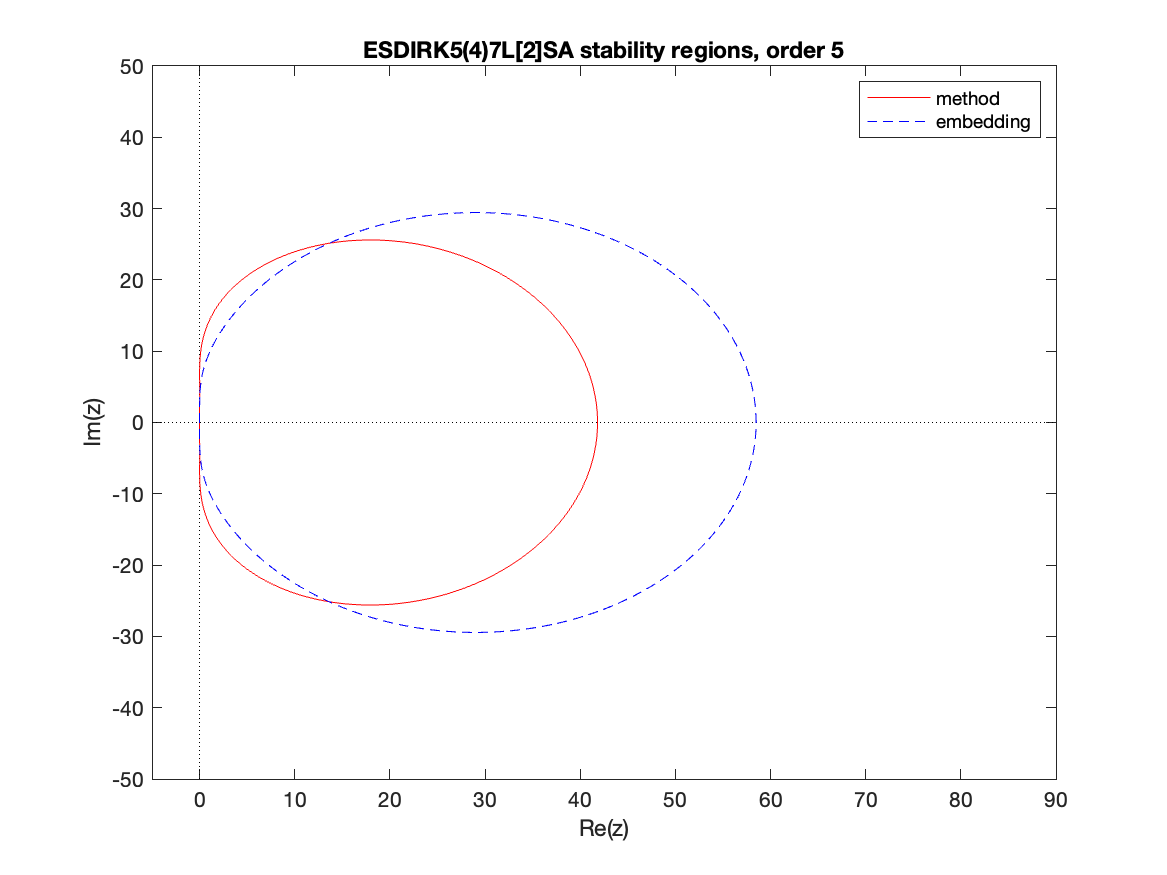
Fig. 2.65 Linear stability region for the ESDIRK547L2SA-7-4-5 method method. The method’s region is outlined in blue; the embedding’s region is in red.
2.8.3. Additive Butcher tables
In the category of additive Runge–Kutta methods for split implicit and explicit calculations, ARKODE includes methods that have orders 2 through 5, with embeddings that are of orders 1 through 4.
Additionally, for each ARK method we provide a plot of the joint linear stability region in the complex plane, as introduced in [168]. This analysis considers the additive Dahlquist test problem
where the additive Runge–Kutta method applies the partition \(f^I(t,y) = \lambda^I y\) and \(f^E(t,y) = \lambda^E y\). Using a step size of \(h\), with corresponding scaled values \(\eta^I = h\lambda^I\) and \(\eta^E = h\lambda^E\), this gives rise to the ARK stability function
Then for a given angle \(\theta \in \left[0,\frac{\pi}{2}\right]\) and radius \(\rho>0\), we may define the joint linear stability region
where the sector \(S(\theta,\rho)\) is defined as
For each ARK method, we overlay plots of the border of \(\mathcal{J}_{\theta,\rho}\) for values \(\theta \in \left\{0^{\circ}, 15^{\circ}, 30^{\circ}, 45^{\circ}, 60^{\circ}, 75^{\circ}, 90^{\circ}\right\}\) and \(\rho=10^8\); roughly corresponding with the shape of the explicit stability region under the assumption that the implicit method is \(A(\theta)\)-stable; the joint stability region decreases in area as \(\theta\) and \(\rho\) increase.
As with traditional Runge–Kutta methods, the value \(\eta^E_0 = -\varepsilon + 0i\) is always within the joint stability region. So in each of the following pictures, the interior of the stability region is the connected region that includes \(\eta_0\).
These ARK Butcher table pairs, and their corresponding joint stability regions, are as follows.
ERK Method ID |
DIRK Method ID |
Stages |
Embedded Order |
Order |
|---|---|---|---|---|
3 |
1 |
2* |
||
3 |
1 |
2 |
||
3 |
1 |
2 |
||
3 |
1 |
2 |
||
4 |
2 |
3* |
||
4 |
2 |
3 |
||
7 |
3 |
4* |
||
6 |
3 |
4 |
||
8 |
4 |
5* |
||
8 |
5 |
5 |
2.8.3.1. ARKODE_ARK2_3_1_2
2nd-order method that combines ARKODE_ARK2_ERK_3_1_2 with
ARKODE_ARK2_DIRK_3_1_2. This is the default
second-order ARK method.

Fig. 2.66 Joint linear stability regions \(\mathcal{J}_{\theta,10^8}\) for the
ARKODE_ARK2_3_1_2 method. All
joint stability regions coincide, so only the \(90^{\circ}\) boundary is visible.
2.8.3.2. ARKODE_ASCHER_ARK_3_1_2
2nd-order method that combines ARKODE_ASCHER_ERK_3_1_2 with
ARKODE_ASCHER_SDIRK_3_1_2.

Fig. 2.67 Joint linear stability regions \(\mathcal{J}_{\theta,10^8}\) for the
ARKODE_ASCHER_ARK_3_1_2 method.
All joint stability regions coincide, so only the \(90^{\circ}\) boundary
is visible.
2.8.3.3. ARKODE_SSP_ARK_3_1_2
2nd-order method that combines ARKODE_SSP_ERK_3_1_2 with
ARKODE_SSP_DIRK_3_1_2.

Fig. 2.68 Joint linear stability regions \(\mathcal{J}_{\theta,10^8}\) for the
ARKODE_SSP_ARK_3_1_2 method.
2.8.3.4. ARKODE_SSP_LSPUM_ARK_3_1_2
2nd-order method that combines ARKODE_SSP_LSPUM_ERK_3_1_2 with
ARKODE_SSP_LSPUM_SDIRK_3_1_2.

Fig. 2.69 Joint linear stability regions \(\mathcal{J}_{\theta,10^8}\) for the
ARKODE_SSP_LSPUM_ARK_3_1_2 method.
2.8.3.5. ARKODE_ARK324L2SA_ARK_4_2_3
3rd-order method that combines ARKODE_ARK324L2SA_ERK_4_2_3
with ARKODE_ARK324L2SA_DIRK_4_2_3.
This is the default third-order ARK method.

Fig. 2.70 Joint linear stability regions \(\mathcal{J}_{\theta,10^8}\) for the
ARKODE_ARK324L2SA_ARK_4_2_3 method. The joint stability regions only
differ near the imaginary axis, so for most of the region only the
\(80^o\) boundary is visible.
2.8.3.6. ARKODE_SSP_ARK_4_2_3
3rd-order method that combines ARKODE_SSP_ERK_4_2_3 with
ARKODE_ESDIRK_4_2_3.

Fig. 2.71 Joint linear stability regions \(\mathcal{J}_{\theta,10^8}\) for the
ARKODE_SSP_ARK_4_2_3 method.

Fig. 2.72 Joint linear stability regions \(\mathcal{J}_{\theta,1}\) for the
ARKODE_SSP_ARK_4_2_3 method. Note that when the implicit partition
is nonstiff, the joint stability region more closely aligns with the
ARKODE_SSP_ERK_4_2_3 stability region.
2.8.3.7. ARKODE_ARK436L2SA_ARK_6_3_4
4th-order method that combines ARKODE_ARK436L2SA_ERK_6_3_4 with
ARKODE_ARK436L2SA_DIRK_6_3_4.
This is the default fourth-order ARK method.

Fig. 2.73 Joint linear stability regions \(\mathcal{J}_{\theta,10^8}\) for the
ARKODE_ARK436L2SA_ARK_6_3_4 method.
2.8.3.8. ARKODE_ARK437L2SA_ARK_7_3_4
4th-order method that combines ARKODE_ARK437L2SA_ERK_7_3_4 with
ARKODE_ARK437L2SA_DIRK_7_3_4.

Fig. 2.74 Joint linear stability regions \(\mathcal{J}_{\theta,10^8}\) for the
ARKODE_ARK437L2SA_ARK_7_3_4 method.
2.8.3.9. ARKODE_ARK548L2SA_ARK_8_4_5
5th-order method that combines ARKODE_ARK548L2SA_ERK_8_4_5 with
ARKODE_ARK548L2SA_DIRK_8_4_5.
This is the default fifth-order ARK method.

Fig. 2.75 Joint linear stability regions \(\mathcal{J}_{\theta,10^8}\) for the
ARKODE_ARK548L2SA_ARK_8_4_5 method.
2.8.3.10. ARKODE_ARK548L2SAb_ARK_8_4_5
5th-order method that combines ARKODE_ARK548L2SAb_ERK_8_4_5 with
ARKODE_ARK548L2SAb_DIRK_8_4_5.

Fig. 2.76 Joint linear stability regions \(\mathcal{J}_{\theta,10^8}\) for the
ARKODE_ARK548L2SAb_ARK_8_4_5 method.
2.8.4. Symplectic Partitioned Butcher tables
In the category of symplectic partitioned Runge-Kutta (SPRK) methods, ARKODE includes methods that have orders \(q = \{1,2,3,4,5,6,8,10\}\). ARKODE’s symplectic partitioned Butcher tables are provided in the enumeration
-
enum ARKODE_SPRKMethodID
with values specified in Table 2.20.
Warning
When using these non-embedded methods, users must specify the
time step by calling ARKodeSetFixedStep().
Method ID |
Stages |
Order |
|---|---|---|
1 |
1* |
|
2 |
2* |
|
2 |
2 |
|
2 |
2 |
|
3 |
3* |
|
3 |
3 |
|
4 |
4* |
|
4 |
4 |
|
6 |
5* |
|
8 |
6* |
|
16 |
8* |
|
36 |
10* |
-
enumerator ARKODE_SPRK_EULER_1_1
Accessible via the constant (or string) ARKODE_SPRK_EULER_1_1 to
ARKodeSPRKTable_Load() or ARKodeSPRKTable_LoadByName().
This is the classic Symplectic Euler method and the default 1st order method.
-
enumerator ARKODE_SPRK_LEAPFROG_2_2
Accessible via the constant (or string) ARKODE_SPRK_LEAPFROG_2_2 to
ARKodeSPRKTable_Load() or ARKodeSPRKTable_LoadByName().
This is the classic Leapfrog/Verlet method and the default 2nd order method.
-
enumerator ARKODE_SPRK_PSEUDO_LEAPFROG_2_2
Accessible via the constant (or string) ARKODE_SPRK_PSEUDO_LEAPFROG_2_2 to
ARKodeSPRKTable_Load() or ARKodeSPRKTable_LoadByName().
This is the classic Pseudo Leapfrog/Verlet method.
-
enumerator ARKODE_SPRK_MCLACHLAN_2_2
Accessible via the constant (or string) ARKODE_SPRK_MCLACHLAN_2_2 to
ARKodeSPRKTable_Load() or ARKodeSPRKTable_LoadByName().
This is the 2nd order method given by McLachlan in [111].
-
enumerator ARKODE_SPRK_MCLACHLAN_3_3
Accessible via the constant (or string) ARKODE_SPRK_MCLACHLAN_3_3 to
ARKodeSPRKTable_Load() or ARKodeSPRKTable_LoadByName().
This is the 3rd order method given by McLachlan in [111]
and the default 3rd order method.
-
enumerator ARKODE_SPRK_RUTH_3_3
Accessible via the constant (or string) ARKODE_SPRK_RUTH_3_3 to
ARKodeSPRKTable_Load() or ARKodeSPRKTable_LoadByName().
This is the 3rd order method given by Ruth in [128].
-
enumerator ARKODE_SPRK_MCLACHLAN_4_4
Accessible via the constant (or string) ARKODE_SPRK_MCLACHLAN_4_4 to
ARKodeSPRKTable_Load() or ARKodeSPRKTable_LoadByName().
This is the 4th order method given by McLachlan in [111]
and the default 4th order method.
Warning
This method only has coefficients sufficient for single or double precision.
-
enumerator ARKODE_SPRK_CANDY_ROZMUS_4_4
Accessible via the constant (or string) ARKODE_SPRK_CANDY_ROZMUS_4_4 to
ARKodeSPRKTable_Load() or ARKodeSPRKTable_LoadByName().
This is the 4th order method given by Candy and Rozmus in [35].
-
enumerator ARKODE_SPRK_MCLACHLAN_5_6
Accessible via the constant (or string) ARKODE_SPRK_MCLACHLAN_5_6 to
ARKodeSPRKTable_Load() or ARKodeSPRKTable_LoadByName().
This is the 5th order method given by McLachlan in [111]
and the default 5th order method.
Warning
This method only has coefficients sufficient for single or double precision.
-
enumerator ARKODE_SPRK_YOSHIDA_6_8
Accessible via the constant (or string) ARKODE_SPRK_YOSHIDA_6_8 to
ARKodeSPRKTable_Load() or ARKodeSPRKTable_LoadByName().
This is the 6th order method given by Yoshida in [167]
and the default 6th order method.
-
enumerator ARKODE_SPRK_SUZUKI_UMENO_8_16
Accessible via the constant (or string) ARKODE_SPRK_SUZUKI_UMENO_8_16 to
ARKodeSPRKTable_Load() or ARKodeSPRKTable_LoadByName().
This is the 8th order method given by Suzuki and Umeno in [154]
and the default 8th order method.
-
enumerator ARKODE_SPRK_SOFRONIOU_10_36
Accessible via the constant (or string) ARKODE_SPRK_SOFRONIOU_10_36 to
ARKodeSPRKTable_Load() or ARKodeSPRKTable_LoadByName().
This is the 10th order method given by Sofroniou and Spaletta in [149]
and the default 10th order method.